
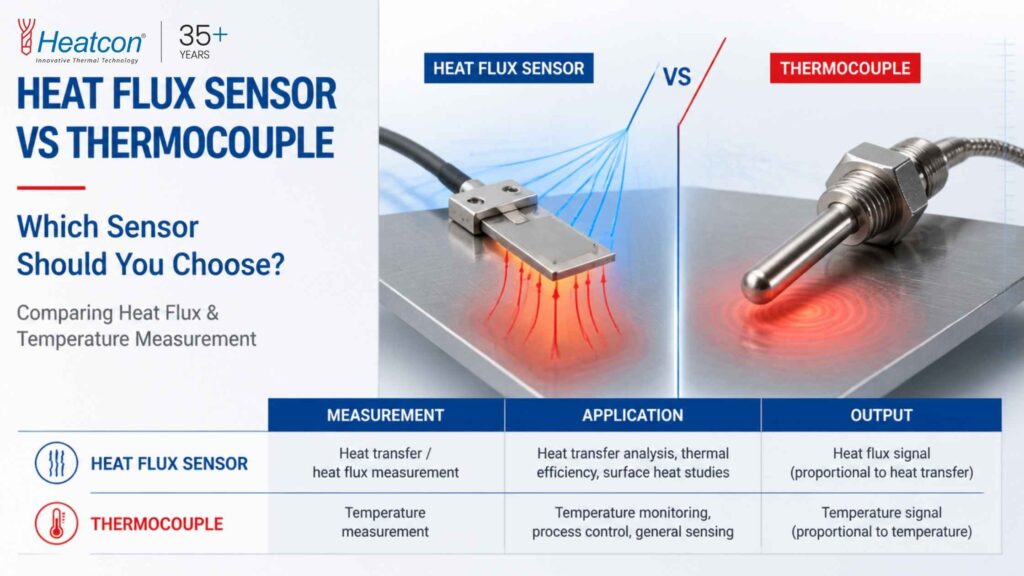
What Is The Difference Between Heat Flux Sensor And Thermocouple?
If you’re seeking to measure heat in challenging environments—be it inside a furnace, across an industrial oven, or within research applications—understanding the heat flux sensor vs thermocouple debate is crucial. In three sentences: Heat flux sensors directly measure the rate of heat transfer per unit area, making them ideal for quantifying thermal performance in real-time. Thermocouples, meanwhile, are renowned for their ability to measure temperature across a vast range of conditions with high durability and speed. The optimal choice depends on whether your priority is direct heat flow measurement or robust temperature monitoring in dynamic environments.
How Do Heat Flux Sensors Work?
A heat flux sensor is specifically engineered to quantify the amount of heat energy passing through a surface per unit time and area, typically measured in watts per square meter (W/m²). It operates by detecting the voltage differential caused by the heat flow through its sensitive layers, translating this into a direct readout of heat transfer. These sensors are indispensable in applications where understanding the actual heat transfer—not just temperature—is critical, such as in insulation testing, material research, and evaluating the efficiency of heat generating equipment.
- Directly measures heat flow
- Ideal for energy efficiency studies and R&D
- Critical for analyzing furnace and oven performance
- Used in aerospace, automotive, and building sciences
How Do Thermocouples Function In Industrial Settings?
Thermocouples are the backbone of industrial temperature monitoring. Constructed from two dissimilar metals joined at one end, they generate a voltage proportional to the temperature difference between the junction and a reference point. This makes them exceptionally versatile for rapid, reliable temperature readings from -200°C to above 1800°C, depending on type.
- Extremely robust and cost-effective
- Suitable for high and low temperature ranges
- Widely used in process industries, HVAC, and laboratory testing
- Compatible with automated control systems
Heat flux sensor comparison: What Sets Them Apart?
When considering a heat flux sensor comparison alongside thermocouples, the difference becomes clear in both functionality and application:
| Feature | Heat Flux Sensor | Thermocouple |
|---|---|---|
| Primary Measurement | Heat flow (W/m²) | Temperature (°C/°F) |
| Typical Applications | R&D, building insulation, energy audits | Process control, safety monitoring, industrial automation |
| Response Time | Moderate to fast | Very fast |
| Durability | Moderate (sensitive layers) | High (robust metals) |
| Cost | Higher | Lower |
To summarize, thermocouples excel in rugged environments where continuous temperature data is crucial, while heat flux sensors shine in scenarios where heat transfer details are necessary for efficiency optimization.
When Should You Choose Heat Flux Sensors Over Thermocouples?
If your primary concern is understanding how much heat is being lost or gained through a surface—such as in testing the insulation of furnaces or ovens—heat flux sensors are the undisputed choice. They are also essential for calibrating thermal models, energy conservation audits, and advanced scientific research.
- Evaluating insulation and energy performance
- Research on new materials and composites
- Calibration of heat transfer models in engineering
Why Do Most Industries Still Rely On Thermocouples?
The answer lies in their simplicity, ruggedness, and cost-effectiveness. Thermocouples are the preferred sensor for high-volume, continuous temperature monitoring across industries. Their flexibility in size, wide temperature range, and ease of integration with controllers and recorders make them indispensable for operational safety and process efficiency.
- Continuous monitoring in harsh environments
- Easy replacement and low maintenance costs
- Fast response for process control
Temperature sensor vs heat flux sensor: Which Is Best For Your Application?
The “temperature sensor vs heat flux sensor” choice boils down to your measurement goal. If you want to know “how hot,” you need a temperature sensor (like a thermocouple or RTD). If you want to know “how much heat is moving,” a heat flux sensor is mandatory.
- Choose a temperature sensor (thermocouple/RTD) for process monitoring, alarms, and control systems.
- Choose a heat flux sensor for energy audits, insulation performance, and scientific analysis of heat transfer.
Thermocouple vs heat flux sensor: A Real-World Perspective
In real-world industrial scenarios, many processes require both temperature and heat flux measurements for a complete picture. For instance, a furnace manufacturer may use thermocouples to control temperature and heat flux sensors to analyze energy losses and optimize insulation. Understanding both parameters can lead to energy savings up to 15% in thermal processing industries.
What Are Thermal Measurement Sensors And Their Broader Impact?
Thermal measurement sensors encompass devices that evaluate temperature, heat flow, and related properties—covering thermocouples, RTDs, heat flux sensors, and more. Their widespread application in industries such as metal processing, food and beverage, pharmaceuticals, and power generation is a testament to their critical role in modern engineering and safety.
Why Trust Heatcon Sensors For Your Industrial Sensor Needs?
Heatcon Sensors is a leading manufacturer of customized RTDs, thermocouples, heat flux sensors, and an extensive range of temperature and thermal measurement sensors. With decades of expertise, Heatcon Sensors delivers tailor-made solutions to industries in India and across the globe—including the US, UAE, Indonesia, Germany, South Korea, Saudi Arabia, Russia, Bahrain, Kuwait, and beyond.
- Custom sensor design for unique industrial environments
- State-of-the-art manufacturing for accuracy and reliability
- Compliance with international quality and safety standards
- Rapid delivery to any city, region, or country worldwide
Heatcon Sensors: Your Partner For Complete Thermal Solutions
Beyond sensors, Heatcon Sensors manufactures a wide range of heat generating equipment, including high-performance furnaces, ovens, hot air blowers, electric furnaces, and high-density cartridge heaters. This comprehensive portfolio ensures that no matter your heating or measurement challenge, Heatcon Sensors can deliver a complete solution.
How To Get Expert Guidance Or Custom Sensors From Heatcon Sensors?
Don’t leave your process optimization to chance. Connect with Heatcon Sensors for personalized recommendations, technical support, and the fastest delivery of custom temperature and heat flux sensors:
- Submit your requirements via the online contact form.
- Message instantly on WhatsApp through the interface on the Heatcon Sensors website.
- Call either +91 9164833027 or +91 9844233244 for immediate technical consultation and quotes.
With Heatcon Sensors, you’re not just buying a sensor—you’re investing in operational excellence and industry-leading support.
About Heatcon Sensors
Heatcon Sensors is a globally recognized manufacturer based in India, specializing in custom RTDs, thermocouples, and advanced thermal measurement solutions. The company is known for its strong commitment to innovation, quality, and customer satisfaction, serving industrial clients across diverse sectors and geographies.
Frequently Asked Questions
What is the main difference between a heat flux sensor and a thermocouple?
The primary difference lies in what each sensor measures: a thermocouple measures temperature, while a heat flux sensor measures the rate of heat transfer per unit area (heat flux). A thermocouple provides direct temperature readings, making it ideal for standard temperature monitoring. In contrast, a heat flux sensor captures how much thermal energy is passing through a material or surface, giving insights into energy flow and efficiency. When considering heat flux sensor vs thermocouple, it’s important to match your choice to whether you need temperature or heat flow data.
When should I select a heat flux sensor over a thermocouple?
Choose a heat flux sensor when you need to quantify the amount and direction of heat energy passing through a surface or material. This is essential in applications such as insulation testing, building envelope studies, and advanced research on heat transfer. If you only require accurate temperature readings at a specific point, a thermocouple is usually sufficient. The thermocouple vs heat flux sensor decision depends on whether your focus is on temperature or energy flow.
How do I compare the performance of heat flux sensors and thermocouples?
For a thorough heat flux sensor comparison with thermocouples, consider accuracy, response time, and intended application. Thermocouples are robust, cost-effective, and ideal for quick temperature measurements, even in harsh environments. Heat flux sensors are more specialized, offering direct heat flow data with high sensitivity, especially in research and quality assurance contexts. The right choice depends on measurement goals and environmental conditions.
Can I use both temperature and heat flux sensors in the same setup?
Absolutely, many experimental and industrial setups benefit from using both. Thermocouples can monitor surface or ambient temperatures, while heat flux sensors provide real-time data on energy transfer. This dual approach enables comprehensive thermal analysis, making it easier to optimize processes and study thermal properties in detail.
What are the typical applications for heat flux sensors and thermocouples?
Thermocouples are widely used across industries for temperature monitoring in HVAC, manufacturing, food processing, and laboratory environments. Heat flux sensors are found in thermal insulation testing, building materials research, electronics cooling, and scientific studies where measuring energy flow is critical. The temperature sensor vs heat flux sensor decision often comes down to whether you need temperature monitoring or deeper insight into energy transfer processes.
How do Heatcon Sensors support both heat flux and temperature measurements?
Heatcon Sensors offers a wide range of thermal measurement sensors, including both high-precision thermocouples and advanced heat flux sensors. Their solutions are engineered for reliability and accuracy, supporting applications from simple temperature monitoring to complex heat flow analysis. Heatcon Sensors can also provide custom sensor designs to meet unique industrial or research requirements.
What factors should I consider when choosing between heat flux and thermocouple sensors?
Key considerations include the type of data required (temperature or heat flux), the physical environment (temperature extremes, humidity, surface properties), installation constraints, response time, and budget. Heatcon Sensors’ experts can guide you through a detailed selection process to ensure you get the most suitable sensor for your needs.
Are Heatcon Sensors’ products compatible with standard industry equipment?
Yes, Heatcon Sensors designs its thermal measurement sensors for compatibility with common data acquisition systems and industry-standard controllers. This ensures seamless integration into existing setups, making upgrades or new installations straightforward and efficient.