
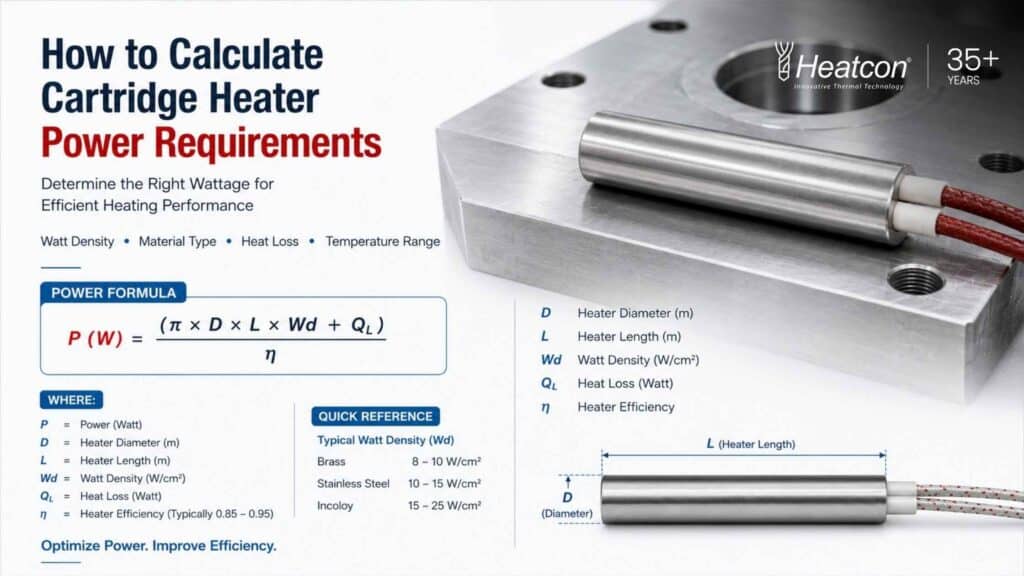
What Is Cartridge Heater Power Calculation?
Cartridge heater power calculation is the process of determining the appropriate electrical power (measured in watts) that a cartridge heater must deliver to effectively heat a specific material or system. This calculation is fundamental to industrial heater design, impacting efficiency, safety, and operational costs. The right calculation ensures your heater matches both the physical and thermal requirements of your application, preventing overheating, underperformance, or premature failure.
Why Is Accurate Heater Watt Calculation Essential?
Accurate heater watt calculation guarantees that your cartridge heater will provide sufficient heat without wasting energy or risking damage to your equipment. Overpowered heaters can cause thermal degradation, while underpowered heaters may result in inadequate heating, process delays, and increased wear.
- Efficiency: Proper power requirements reduce energy consumption.
- Longevity: Well-sized heaters last longer and require less maintenance.
- Safety: Prevents equipment failure, fire hazards, and process interruptions.
How To Perform Cartridge Heater Power Calculation
To calculate the power requirements for a cartridge heater, you must consider several variables, including the material to be heated, its mass, specific heat, temperature rise, and heat losses.
Step-by-step power calculation process
- Determine the Mass (M):
Find the mass (in kilograms) of the material or object to be heated.
- Identify Specific Heat (C):
Use the specific heat value (in J/kg°C) for the material.
- Calculate Temperature Increase (ΔT):
Subtract the initial temperature from the desired final temperature (in °C).
- Estimate Heat Losses:
Factor in heat lost to the environment (usually 10-30% of total).
- Time Requirement (t):
Specify the required heating time (in seconds).
- Use The Heater Sizing Formula:
Power (W) = [Mass (kg) × Specific Heat (J/kg°C) × ΔT (°C)] / Time (seconds) + Heat Losses (W)
This heater sizing formula gives a baseline for cartridge heater power calculation. For instance, if you need to heat 5 kg of aluminum (specific heat: 900 J/kg°C) by 80°C in 600 seconds, and estimate 20% heat loss, the calculation would be:
Power = [5 × 900 × 80] / 600 = 600W
Total Power with 20% loss = 600 + (0.2 × 600) = 720W
What Is Watt Density Calculation And Why Does It Matter?
Watt density calculation determines the amount of power (in watts) distributed per square inch of heater surface area. This metric is essential to prevent overheating and ensure efficient heat transfer. High watt density can lead to rapid temperature rise and possible heater burnout, while low watt density may result in slow heating.
| Application | Watt Density (W/in²) |
|---|---|
| Plastic Injection Molds | 20-40 |
| Packaging Equipment | 40-60 |
| Metal Heating | 60-120 |
Always match your watt density calculation to the thermal conductivity of the material and your application’s requirements. Heatcon Sensors’ engineering team can assist you in selecting the ideal cartridge heater configuration for your specific needs.
How Does Industrial Heater Design Influence Power Requirements?
Industrial heater design integrates power requirements, watt density calculation, physical dimensions, sheath materials, and control strategies. The best industrial heater design balances rapid heat-up times, uniform temperature distribution, and long service life.
- Heater sheath material (stainless steel, Incoloy, etc.) affects heat transfer and corrosion resistance.
- Heater length and diameter impact watt density and fitment.
- Control systems (thermostats, RTDs, thermocouples) refine temperature accuracy.
- Custom design ensures compatibility with your process and installation environment.
With Heatcon Sensors, you access advanced industrial heater design expertise—delivering high-density cartridge heaters, immersion heaters, band heaters, strip heaters, and more, tailored to your operational goals.
What Industries And Regions Benefit From Custom Cartridge Heater Power Calculation?
Heatcon Sensors supports global and local industries with precision-engineered heating solutions. Whether you operate in India’s bustling manufacturing hubs, the oil fields of the UAE and Saudi Arabia, Germany’s automotive sector, or emerging markets like Indonesia and South Korea, accurate cartridge heater power calculation is non-negotiable for efficiency and safety.
Heatcon Sensors can custom manufacture and supply temperature sensors and heating elements to any part of India—including Bengaluru, Mumbai, Delhi, Chennai, Hyderabad, and Pune—or to industrial hotspots worldwide, such as the US, Russia, Bahrain, and Kuwait.
How Can Heatcon Sensors Help With Your Cartridge Heater Power Calculation?
If you’re seeking reliable heater watt calculation, the right heater sizing formula, and robust support in industrial heater design, Heatcon Sensors stands out as your trusted partner. As a leader in the manufacture of customized RTDs, thermocouples, temperature sensors, and heat generating equipment—including furnaces, ovens, hot air blowers, and high density cartridge heaters—Heatcon Sensors delivers solutions that are engineered for your success.
- Expert Consultation: Share your process details, and Heatcon’s engineers will advise on the best power requirements for your application.
- Custom Solutions: Get heaters and sensors designed to your specifications, no matter the scale or complexity.
- Global Reach: Heatcon Sensors ships products across India and to international markets, ensuring timely delivery and support.
- End-to-End Service: From initial cartridge heater power calculation to after-sales support, Heatcon Sensors is with you every step of the way.
Don’t risk costly downtime or inefficient heating—partner with Heatcon Sensors for proven expertise and top-tier products.
What Information Should You Provide For Accurate Heater Power Requirements?
To calculate the most accurate power requirements for your cartridge heater, provide the following details to Heatcon Sensors:
- Material to be heated (type and mass)
- Initial and desired final temperatures
- Heating time constraints
- Operating environment (ambient temperature, insulation, airflow)
- Heater dimensions and installation constraints
- Voltage and power supply details
This information allows Heatcon Sensors to optimize your heater watt calculation and select or design the best heater for your application.
About Heatcon Sensors
Heatcon Sensors is a globally recognized manufacturer based in Bengaluru, India, specializing in custom-designed RTDs, thermocouples, temperature sensors, and industrial heating equipment. With a reputation for innovation, reliability, and client-focused engineering, Heatcon Sensors serves industries across India, the US, UAE, Indonesia, Germany, South Korea, Saudi Arabia, Russia, Bahrain, Kuwait, and beyond.
Heatcon Sensors’ products are trusted in critical sectors such as plastics, packaging, chemicals, oil & gas, food processing, pharmaceuticals, and automotive manufacturing. By combining precision cartridge heater power calculation, advanced heater sizing formula, and robust industrial heater design, Heatcon Sensors ensures your thermal processes are always in expert hands.
Contact Heatcon Sensors For Precision Heating Solutions
Ready to optimize your cartridge heater power calculation and industrial heating performance? Reach out to Heatcon Sensors today:
- Submit your information via our online form
- Message us on WhatsApp through the interface at Heatcon Sensors’ website
- Call us for immediate assistance at +91 9164833027 or +91 9844233244
Don’t let your operation settle for less—choose Heatcon Sensors for industry-leading expertise in cartridge heater power calculation, heater watt calculation, heater sizing formula, and industrial heater design. Experience the difference of working with a partner who understands your unique power requirements and delivers every time, wherever you are.
Frequently Asked Questions
What is cartridge heater power calculation and why is it important?
Cartridge heater power calculation is the process of determining the required wattage for a cartridge heater to efficiently heat your application. This calculation ensures that the heater delivers enough energy to reach your desired temperature within the needed time, without overheating or consuming excessive energy. Proper power requirements calculation is crucial for safety, performance, and energy efficiency in industrial heater design.
How do I perform heater watt calculation for my application?
Heater watt calculation involves assessing the total heat energy needed to raise your material to the target temperature. The general approach is to use the formula: Watts = (Mass × Specific Heat × Temperature Rise) / Time . You may also need to factor in heat losses due to conduction, convection, or radiation. Heatcon Sensors can assist you in performing these calculations accurately for your specific process.
What is the standard heater sizing formula for cartridge heaters?
The standard heater sizing formula is: Power (W) = (Mass × Specific Heat × ΔT) / Time + Heat Losses , where ΔT is the desired temperature increase. This formula ensures you select a heater that has enough power to achieve your heating goals, accounting for both the material to be heated and environmental losses. Heatcon Sensors provides expert guidance and calculation tools to help you use this formula effectively for cartridge heaters.
Why is watt density calculation critical in industrial heater design?
Watt density calculation refers to the amount of wattage per unit area of the heater’s surface. It is critical in industrial heater design because improper watt density can lead to premature heater failure or inefficient heating. A watt density too high may cause overheating and damage, while too low can result in sluggish performance. Heatcon Sensors recommends the optimal watt density based on your material and application, ensuring reliability and longevity.
How do Heatcon Sensors assist with cartridge heater power calculation?
Heatcon Sensors offers personalized support for cartridge heater power calculation by understanding your process requirements, application environment, and material properties. Our team uses advanced software and decades of experience to recommend the right heater wattage, size, and watt density, ensuring you achieve optimal heating performance with safety and efficiency in mind.
What factors impact the power requirements of a cartridge heater?
Key factors affecting cartridge heater power requirements include the mass and specific heat of the material, the desired temperature increase, heat-up time, ambient temperature, and heat losses through insulation or the environment. Application specifics, such as whether the heater is inserted in a solid or used for air/gas heating, also play a role. Heatcon Sensors evaluates all these factors to ensure accurate heater sizing and selection.
Can Heatcon Sensors help with custom industrial heater design?
Absolutely. Heatcon Sensors specializes in industrial heater design, including custom cartridge heaters tailored to your specifications. Whether you need unique dimensions, specific watt density, or specialized materials, our engineering team collaborates with you to develop solutions that meet your exact process needs, from concept to installation.
How do I ensure my cartridge heater is sized correctly for my application?
Correct sizing requires using the heater sizing formula, considering all process parameters, and performing a watt density calculation to match your material and heat-up rate. It’s best to consult with experts like those at Heatcon Sensors, who can review your application details and recommend the most suitable cartridge heater for reliable, efficient operation.
What makes Heatcon Sensors a reliable partner for industrial heating solutions?
Heatcon Sensors brings decades of expertise in cartridge heater power calculation, industrial heater design, and custom heating solutions. Our team is committed to quality, precision, and customer satisfaction, offering end-to-end support from design assistance to after-sales service. We use industry best practices and advanced technologies to deliver heaters that perform reliably in the most demanding environments.