
Understanding Wireless Thermocouple Sensors in High-Temperature Environments
A Wireless Thermocouple Sensor is a device engineered to measure and transmit temperature data from high-temperature environments without the use of physical wiring. According to a 2022 MarketsandMarkets report, the global wireless sensor market is projected to reach $16.6 billion by 2025, with industrial temperature sensing as one of its fastest-growing segments. Industries that rely on precise thermal management—such as metal processing, glass manufacturing, and energy production—require reliable and flexible solutions to prevent downtime and inaccuracies.
In areas where traditional wired solutions may fail or are expensive to maintain, wireless thermocouple sensors provide seamless, safe, and accurate monitoring. Real-time data transmission enables industries to optimize processes, enhance safety, and improve productivity and cost efficiency.
How Wireless Thermocouple Sensors Operate
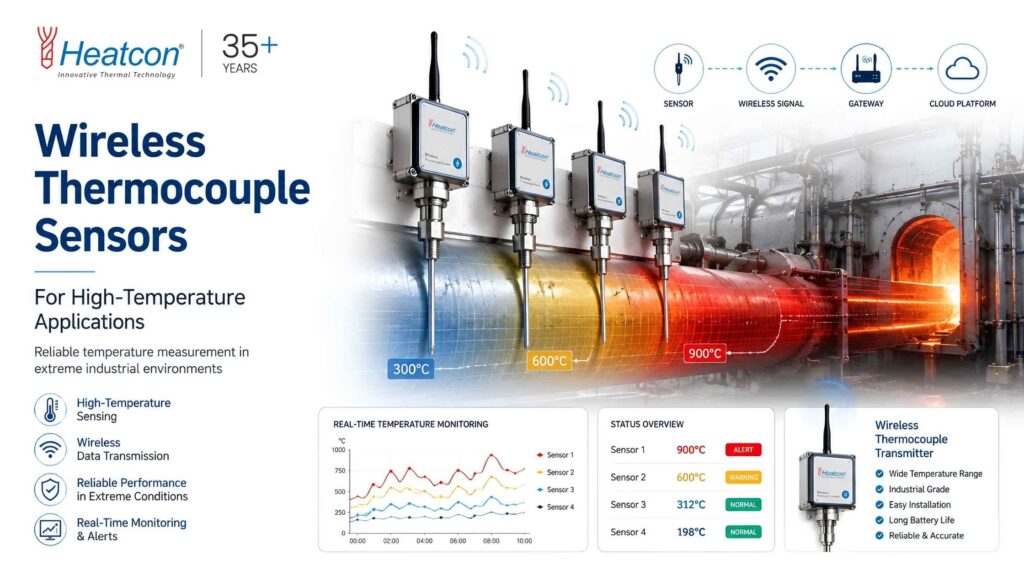
Wireless thermocouple sensors integrate advanced thermocouple sensing elements with wireless transmitters, allowing transmission of temperature data over radio frequencies or Wi-Fi networks. When positioned in environments such as furnaces, industrial ovens, or chemical reactors, they continuously monitor temperature and transmit readings wirelessly to control rooms, mobile devices, or cloud-based platforms.
- Sensor probe—typically a wireless K type thermocouple or another industrial thermocouple chosen for the application
- Wireless transmitter—encapsulated for high-temperature resilience, transmitting data securely
- Receiver or gateway—collects data for analysis, alarms, or process control integration
This approach eliminates complex cabling, reducing installation time, minimizing maintenance, and mitigating operational risks.
The Impact of Wireless Temperature Measurement on Industrial Processes
Wireless temperature measurement is changing industrial operations by providing flexibility, safety, and actionable insights. Without the limitations of cables, engineers can now monitor difficult-to-reach locations, automate data collection, and respond quickly to process changes.
- Enhanced safety for personnel by reducing exposure to high-temperature areas
- Reduced downtime due to elimination of cable failures or wear
- Real-time, remote access to temperature data from multiple locations
- Scalable solutions for large or distributed facilities without costly rewiring
These advantages are especially significant in steel, glass, cement, petrochemicals, and food processing industries, where precise thermal monitoring supports product quality and operational integrity.
Applications of Wireless Thermocouple Sensors
Wireless thermocouple sensors are used broadly across various sectors:
- Furnace sensors for continuous thermal monitoring in steel, aluminum, and ceramics industries
- High-temperature monitoring in glass melting tanks and foundries
- Oven and kiln temperature profiling
- Petrochemical reactor monitoring
- Industrial heating sensors for boilers, heat exchangers, and incinerators
- Thermal monitoring in energy plants and renewable energy facilities
- Remote monitoring of pipelines and storage tanks
Wireless monitoring is now an essential part of maintaining process stability and meeting compliance requirements in these demanding settings.
Heatcon Sensors’ Role in Advancing High-Temperature Monitoring
Heatcon Sensors is an Indian manufacturer and global supplier of customized RTDs, industrial thermocouple assemblies, and advanced temperature sensors. With over three decades of experience and a record of serving a wide range of industries, the company has developed solutions tailored to the complex needs of customers across India, the United States, UAE, Indonesia, Germany, South Korea, Saudi Arabia, Russia, Bahrain, Kuwait, and other regions.
Heatcon Sensors’ offerings include:
- Custom wireless thermocouple sensor solutions for extreme environments
- Wireless K type thermocouple and other sensor types engineered for accuracy and durability
- Turnkey integration with wireless transmitter systems for seamless data collection
- Application support and consultation for high-temperature monitoring projects
Heatcon Sensors’ solutions are deployed in facilities around the world, supporting industries from steel and glass to petrochemicals and energy.
Key Advantages of Heatcon Sensors in the Industrial Heating Market
Heatcon Sensors specializes in custom-engineered temperature solutions, taking a project-specific approach that begins with understanding each customer’s process challenges and monitoring requirements. Its portfolio includes wireless thermocouple sensor designs, high-reliability wireless K type thermocouple assemblies, and rugged industrial thermocouple probes—designed for accuracy and longevity in demanding environments.
In addition to sensors, Heatcon Sensors also manufactures a range of heat generating equipment, such as:
- Industrial furnaces (electric and fuel-fired)
- Ovens for curing, drying, or heat treatment
- Hot air blowers for process heating
- Custom electric furnaces for laboratory and industrial use
- High density cartridge heaters
- Immersion heaters, tubular heaters, and more
This broad expertise enables Heatcon Sensors to deliver comprehensive solutions for industrial heating and high-temperature monitoring needs.
Guidance on Choosing a Wireless Thermocouple Sensor
Selecting the appropriate wireless thermocouple sensor requires matching sensor type, temperature range, and wireless transmitter technology to the specific process environment. Key considerations include:
- Temperature range: Choose a thermocouple type (such as wireless K type thermocouple) rated for your application’s temperature extremes.
- Mounting and enclosure: Ensure the sensor is suitable for the physical, chemical, or mechanical stresses of your environment.
- Wireless communication: Select a transmitter compatible with your facility’s infrastructure (e.g., RF, Wi-Fi, LoRaWAN).
- Data integration: Confirm compatibility with SCADA, DCS, or cloud analytics platforms.
- Compliance and certifications: For hazardous or regulated environments, ensure all components meet the necessary standards.
The Heatcon Sensors team offers consultation and customization to help users identify and implement reliable thermal monitoring solutions tailored to their requirements.
Why Industry Professionals Select Heatcon Sensors for High-Temperature Solutions
Many organizations rely on Heatcon Sensors as a partner for high-temperature monitoring. Reasons for this trust include:
- Global reach: Manufacturing and supply capabilities across India, the USA, UAE, Indonesia, Germany, South Korea, Saudi Arabia, Russia, Bahrain, and Kuwait
- End-to-end support: Application engineering and after-sales service
- Established experience: A record of installations in diverse industrial environments
- Compliance with international industry standards and certifications
- Responsiveness: Support for urgent requirements
Heatcon Sensors’ solutions are used in industries worldwide, supporting precision, safety, and efficiency in modern high-temperature processes. The company’s reputation is reflected in its adherence to quality standards, its ISO 9001:2015 certification, and the successful deployment of solutions in various sectors.
Contacting Heatcon Sensors for Custom Solutions
For more information about how wireless thermocouple sensors and high-temperature monitoring solutions could benefit your facility, Heatcon Sensors offers several ways to get in touch:
- Submit your information: Contact Form
- WhatsApp: Leave a message via the WhatsApp interface on the Heatcon Sensors website
- Call: +91 9164833027 or +91 9844233244 for direct assistance
Heatcon Sensors provides solutions to support safer, more efficient, and smarter thermal monitoring across industries.
About Heatcon Sensors
Heatcon Sensors is a manufacturer and supplier of industrial temperature sensors and heating equipment based in India, with a global presence across the Americas, Europe, the Middle East, and Asia. Specializing in wireless thermocouple sensor solutions, custom RTDs, industrial heating sensors, and a range of heat generating equipment, Heatcon Sensors is committed to quality, innovation, and customer service. The company is ISO 9001:2015 certified and supports clients in both standard and highly specialized applications.
For more details about Heatcon Sensors and the complete product range, visit heatconsensors.com.
Frequently Asked Questions
What is a Wireless Thermocouple Sensor and how does it work in high-temperature applications?
A Wireless Thermocouple Sensor is a device that measures temperature using a thermocouple element and transmits the readings wirelessly to a receiver or data system. In high-temperature applications—such as furnaces, ovens, and industrial heating environments—it allows for real-time temperature monitoring without the need for long wiring runs, reducing installation complexity and improving safety. Heatcon Sensors offers robust wireless thermocouple solutions designed to withstand harsh, high-temperature industrial environments.
What are the advantages of using a wireless K type thermocouple in industrial settings?
The wireless K type thermocouple is popular in industrial thermocouple applications due to its broad temperature range, durability, and accuracy. When paired with wireless transmission, it eliminates wiring issues, reduces maintenance, and enables flexible sensor placement. Heatcon Sensors’ wireless K type thermocouple solutions are engineered for reliable performance in challenging, high-temperature monitoring scenarios.
How does wireless temperature measurement benefit industrial heating sensors?
Wireless temperature measurement simplifies sensor installation and reduces potential points of failure associated with wired connections. For industrial heating sensors, this means enhanced reliability, easier maintenance, and the ability to monitor hard-to-access locations. Heatcon Sensors integrates wireless transmitter technology into their thermal monitoring products, providing seamless data flow for critical process control.
Are Heatcon Sensors’ furnace sensors suitable for extreme heat environments?
Yes, Heatcon Sensors’ furnace sensors are specifically designed for high-temperature monitoring in demanding industrial processes. These sensors utilize robust thermocouple elements and wireless transmitter modules to provide accurate and reliable readings in furnaces, kilns, and other high-heat equipment.
What types of industrial thermocouple sensors does Heatcon Sensors offer for wireless applications?
Heatcon Sensors offers a variety of industrial thermocouple types for wireless applications, including K, J, T, and N types. These are available in different sheath materials and configurations to suit various high-temperature and corrosive environments. All sensors are compatible with advanced wireless transmitter systems for remote data collection and monitoring.
How does Heatcon Sensors ensure data accuracy and reliability in wireless thermal monitoring?
Heatcon Sensors utilizes high-quality thermocouple materials, precise calibration, and secure wireless protocols to ensure data accuracy and reliability in all wireless thermal monitoring solutions. The use of industrial-grade wireless transmitters and advanced signal processing helps maintain reliable temperature data even in electrically noisy or high-temperature environments.
What are the installation requirements for Heatcon Sensors’ wireless thermocouple systems?
Installation of Heatcon Sensors’ wireless thermocouple systems is straightforward. Sensors are positioned at measurement points, while the wireless transmitter is securely mounted nearby. The system requires a compatible receiver or gateway to collect and process data. Power requirements depend on the specific model; some operate on batteries, while others may need wired power. Detailed installation guides and support are provided with every solution.
Can Heatcon Sensors’ wireless thermocouples be integrated with existing industrial control systems?
Absolutely. Heatcon Sensors’ wireless thermocouple solutions are designed for seamless integration with most industrial automation and SCADA systems. The wireless temperature measurement data can be transmitted to PLCs, HMIs, or cloud-based monitoring platforms, supporting real-time alerts and process control.