
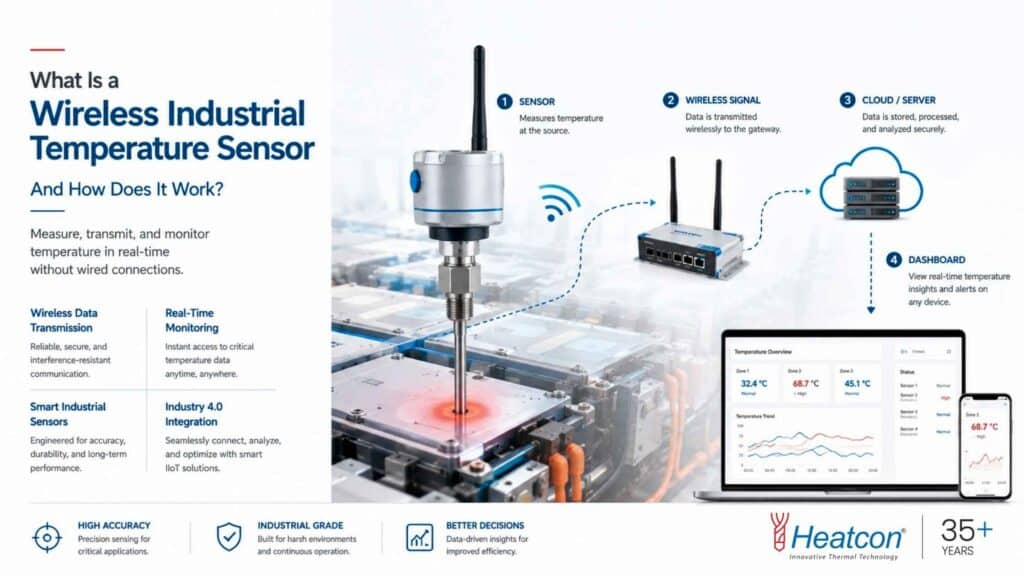
What Is A Wireless Industrial Temperature Sensor?
A Wireless Industrial Temperature Sensor is an advanced electronic instrument used to detect temperature changes and relay this information wirelessly to a centralized monitoring system or controller. Unlike traditional wired sensors, these devices eliminate complex cabling, making installation flexible, cost-effective, and scalable for large industrial sites.
- Wireless RTD sensor: Utilizes resistance temperature detectors (RTDs) for highly accurate and stable temperature readings, ideal for critical industrial processes.
- Wireless thermocouple: Employs thermocouple technology for a wide range of temperature measurement, suitable for harsh environments and rapid temperature fluctuations.
These sensors are often paired with a temperature transmitter, which converts the sensor’s signal into wireless data, streamlining integration with industrial monitoring and control systems.
How Do Wireless Industrial Temperature Sensors Work?
Wireless Industrial Temperature Sensor Working is based on the principle of converting temperature changes into electrical signals, which are then transmitted wirelessly to a receiver or gateway. The sensor detects temperature fluctuations, processes the signal through a temperature transmitter, and communicates this data for analysis and action.
- Sensing: The sensor (RTD or thermocouple) detects temperature changes from industrial equipment or processes.
- Signal Conversion: The temperature transmitter converts this signal into a standardized digital format.
- Wireless Transmission: The converted data is sent wirelessly, often using protocols like Zigbee, LoRa, or Wi-Fi.
- Data Collection: Receivers or gateways aggregate the data for industrial monitoring, remote temperature sensing, and process control.
This wireless monitoring system allows industries to access real-time temperature measurement, reducing manual inspection and minimizing downtime by enabling predictive maintenance and instant alerts.
The Role of Wireless Sensors in Modern Industry
The demand for wireless monitoring and IoT sensors is rising as industries seek to digitize operations for efficiency, sustainability, and safety. Key benefits include:
- Easy Installation: No complex wiring — ideal for retrofitting in existing facilities.
- Scalability: Add sensors as needed, expanding your monitoring network effortlessly.
- Remote Accessibility: Get temperature data from inaccessible or hazardous locations through remote temperature sensing.
- Real-Time Alerts: Receive instant updates on deviations, helping prevent costly downtime or safety incidents.
- Lower Maintenance: Reduced wear and tear due to fewer physical connections.
For industries such as pharmaceuticals, oil & gas, food processing, metal treatment, and power generation, wireless industrial temperature sensors streamline compliance, enhance process reliability, and reduce operational costs.
Types of Wireless Industrial Temperature Sensors
There are two main sensor types used in wireless industrial temperature measurement:
| Sensor Type | Best For | Features |
|---|---|---|
| Wireless RTD sensor | Precision-critical applications | High accuracy, stability, long-term reliability |
| Wireless thermocouple | Wide temperature ranges | Fast response, robust in extreme conditions |
Both types can be integrated with IoT sensors for enhanced data analytics and cloud-based monitoring, supporting wireless monitoring across diverse environments.
Temperature Transmitters and IoT Sensors in Industrial Monitoring
A temperature transmitter is the intermediary that facilitates Wireless Industrial Temperature Sensor Working. It receives the analog signal from the sensor, digitizes it, and sends it wirelessly to a central hub or IoT platform. When paired with IoT sensors, this creates a robust industrial monitoring ecosystem that supports:
- Predictive Maintenance: Early detection of anomalies prevents failures.
- Quality Assurance: Continuous temperature measurement ensures process consistency.
- Compliance: Automated data logs help meet regulatory requirements.
- Scalable Integration: Easily sync with existing SCADA, PLC, or cloud-based systems.
Together, wireless temperature transmitters and IoT sensors provide a comprehensive solution for wireless monitoring and data-driven decision-making.
Applications of Wireless Industrial Temperature Sensors
These sensors are deployed in a multitude of industries and environments, including:
- Process Industries: Chemical, petrochemical, and refinery plants
- Food & Beverage: Cold storage, ovens, fermentation, and HACCP monitoring
- Metallurgy: Furnaces, kilns, and smelters
- Pharmaceuticals: Clean rooms and production lines
- HVAC: Building management and climate control systems
- Energy: Power plants, renewable energy farms
In each of these applications, wireless industrial temperature sensors provide reliable, uninterrupted, and high-precision temperature measurement, driving operational excellence.
Heatcon Sensors: Customized Solutions for Industrial Needs
Heatcon Sensors is a leading manufacturer of customized RTDs, thermocouples, and all forms of temperature sensors for industrial requirements. Based in India, Heatcon Sensors has earned a reputation for delivering precision-engineered solutions globally — including to the US, UAE, Indonesia, Germany, South Korea, Saudi Arabia, Russia, Bahrain, and Kuwait.
- Custom Manufacturing: Each sensor is designed to client specifications, ensuring perfect fit and function.
- Global Reach: Heatcon Sensors delivers temperature sensors to any part of India and worldwide, covering major cities and industrial hubs.
- Comprehensive Solutions: In addition to RTDs and thermocouples, Heatcon Sensors manufactures heat generating equipment such as industrial furnaces, ovens, hot air blowers, electric furnaces, and high density cartridge heaters.
- Reliability: Every product is tested for accuracy, durability, and performance in demanding environments.
Working with Heatcon Sensors provides the assurance of process quality, safety, and efficiency supported by years of experience and technical expertise.
Ordering Customized Temperature Sensors from Heatcon Sensors
Heatcon Sensors makes it simple to get the wireless industrial temperature solutions you need, wherever you are in India or across the globe. Choose from any of these convenient options:
- Submit your information on the form at https://heatconsensors.com/contact-us/
- Leave a message on WhatsApp through the interface available on the Heatcon Sensors website
- Call for immediate assistance on +91 9164833027 or +91 9844233244
With dedicated engineering support and world-class manufacturing, Heatcon Sensors ensures you never have to settle for less than the best in wireless RTD sensor, wireless thermocouple, and temperature transmitter technology.
About Heatcon Sensors
Heatcon Sensors is an ISO-certified manufacturer based in India, specializing in the design and production of custom RTDs, thermocouples, temperature sensors, and heat generating equipment. With decades of experience and a global distribution network, Heatcon Sensors is trusted by industry leaders for excellence in industrial monitoring, remote temperature sensing, and wireless monitoring solutions.
For more information, visit Heatcon Sensors.
Frequently Asked Questions
What is a wireless industrial temperature sensor and how does it work?
A wireless industrial temperature sensor is a device designed to measure temperature in industrial environments and transmit the readings wirelessly to a central system for monitoring and control. The Wireless Industrial Temperature Sensor Working principle involves a sensing element such as a wireless RTD sensor or wireless thermocouple, a temperature transmitter, and a wireless module. Together, they collect accurate temperature data and send it via radio frequency or other wireless protocols to receivers or IoT platforms, enabling remote temperature sensing and real-time industrial monitoring without the need for physical wiring.
What are the benefits of using wireless temperature sensors in industrial applications?
Wireless temperature sensors offer several benefits for industrial monitoring, including simplified installation (no cabling required), reduced maintenance, lower costs, and enhanced safety by minimizing wiring in hazardous areas. They also facilitate remote temperature sensing in hard-to-reach locations and seamlessly integrate with modern IoT sensors and wireless monitoring platforms for improved process control and predictive maintenance.
How do Heatcon Sensors’ wireless RTD sensor and wireless thermocouple solutions differ?
Heatcon Sensors offers both wireless RTD sensor and wireless thermocouple solutions to address a wide range of temperature measurement needs. Wireless RTD sensors are known for their high accuracy and stability, making them ideal for applications requiring precise readings. Wireless thermocouples, on the other hand, are robust and capable of measuring a broader temperature range, making them suitable for extreme industrial environments. Both types utilize advanced temperature transmitters and wireless technology for reliable data transmission and seamless integration with industrial monitoring systems.
How is data transmitted from a wireless industrial temperature sensor?
In Heatcon’s solutions, the temperature transmitter connected to the sensing element (such as an RTD or thermocouple) digitizes the temperature measurement and then transmits the data wirelessly. The transmission typically uses RF, Zigbee, LoRa, or Wi-Fi protocols, allowing the sensor data to be received by a central gateway, PLC, or IoT platform for further analysis and action. This enables efficient wireless monitoring and remote access to real-time temperature data.
What makes Heatcon Sensors’ wireless solutions suitable for industrial monitoring?
Heatcon Sensors specializes in rugged, industrial-grade wireless temperature sensors designed to withstand harsh conditions, temperature extremes, and electromagnetic interference. Their wireless RTD sensors and thermocouples are engineered for accuracy, reliability, and long battery life, ensuring continuous industrial monitoring. In addition, their solutions offer easy integration with existing SCADA, PLC, and cloud-based IoT sensors and systems, supporting scalable temperature measurement and control.
Can Heatcon Sensors’ wireless temperature transmitters be integrated with IoT platforms?
Yes, Heatcon Sensors’ wireless temperature transmitter models are designed for seamless integration with modern IoT platforms. This compatibility allows users to leverage remote temperature sensing, advanced analytics, and dashboard-based wireless monitoring for proactive maintenance, process optimization, and regulatory compliance in industrial settings.
What applications are ideal for wireless industrial temperature sensors?
Wireless industrial temperature sensors from Heatcon Sensors are ideal for applications such as chemical processing, food manufacturing, power generation, oil & gas, pharmaceuticals, and any scenario requiring remote temperature sensing or monitoring in challenging environments. Their robust design and wireless capability make them perfect for both stationary and mobile equipment temperature measurement.
How does remote temperature sensing improve plant safety and efficiency?
Remote temperature sensing allows for real-time wireless monitoring of critical equipment and processes from a safe distance, reducing the need for manual checks in hazardous or hard-to-access areas. This not only enhances worker safety but also enables rapid detection of anomalies, minimizing downtime and improving operational efficiency through timely maintenance and data-driven decisions.