
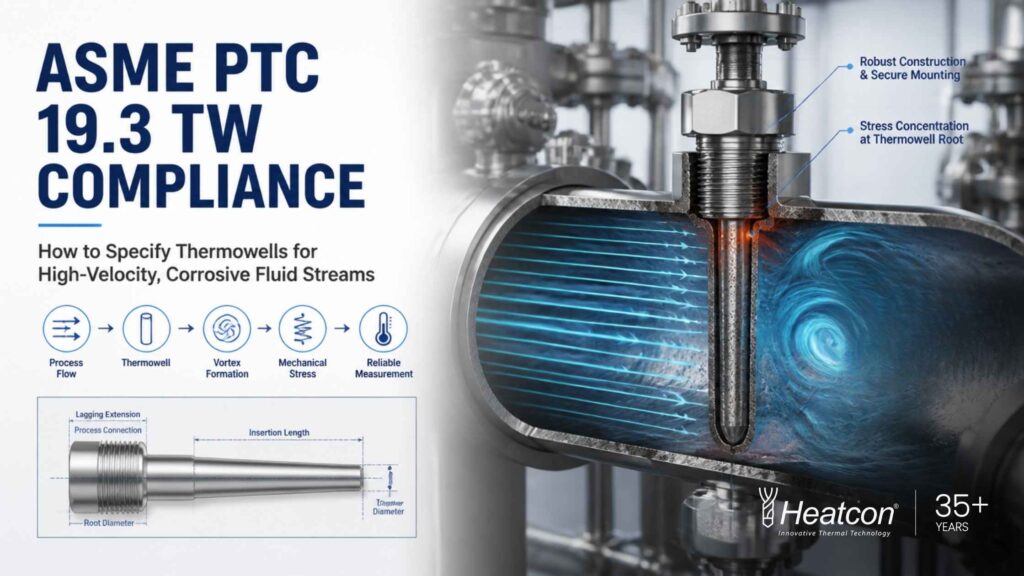
Did you know that according to industry research, over 60% of unscheduled shutdowns in high-velocity piping systems are due to inadequate thermowell specification or failure? ASME PTC 19.3 TW compliance is not just a regulatory requirement but a necessity for ensuring operational safety, reliability, and process efficiency, especially when dealing with corrosive fluid temperature measurement in challenging environments.
What Is ASME PTC 19.3 TW And Why Is It Crucial?
ASME PTC 19.3 TW is the globally recognized standard for evaluating thermowell design and performance under various process conditions. It provides methodologies to ensure that thermowells installed in piping systems—especially those exposed to high-velocity, high-pressure, and corrosive fluids—are structurally sound and do not pose a risk of vibration-induced fatigue failure.
- Ensures mechanical integrity and process safety
- Mandates wake frequency calculation thermowell analysis
- Reduces risk of catastrophic thermowell failures
This standard is essential for engineers and maintenance teams in the oil & gas, chemical, power generation, and pharmaceutical industries. Heatcon Sensors excels in designing and manufacturing thermowells that comply with ASME PTC 19.3 TW, ensuring your installations meet or exceed global safety benchmarks.
How To Specify Thermowells For High-Velocity, Corrosive Fluid Streams
The challenge in high-velocity, corrosive applications lies in balancing structural strength, chemical compatibility, and measurement accuracy. To specify a compliant thermowell, you need to consider the following aspects:
- Understand the process conditions (fluid velocity, pressure, temperature, corrosiveness)
- Follow a systematic thermowell selection guide
- Use accurate wake frequency calculation thermowell methods
- Select appropriate thermowell materials
- Review flanged thermowell dimensions for fit and functionality
- Ensure the design meets ASME PTC 19.3 TW requirements
Thermowell Selection: Key Considerations
A robust thermowell selection guide is indispensable for specifying the right solution for aggressive and high-velocity fluid streams. The guide should address:
- Fluid and process parameters (velocity, pressure, temperature, composition)
- Corrosive fluid temperature measurement needs
- Insertion length and immersion requirements
- Mounting style (flanged, threaded, welded)
- Thermowell materials compatibility (e.g., SS316, Inconel, Hastelloy)
- Compliance with flanged thermowell dimensions and piping standards
- Vibration and resonance risk assessment (wake frequency calculation thermowell)
Importance of Wake Frequency Calculations
The wake frequency calculation thermowell analysis is mandated by ASME PTC 19.3 TW. This calculation assesses the risk of resonance-induced vibrations by comparing the natural frequency of the thermowell to the vortex shedding frequency caused by fluid flow. A typical requirement is a safety factor of at least 2.2 between the thermowell’s natural frequency and the expected vortex shedding frequency for safe operation.
- Critical for high-velocity and high-pressure applications
- Reduces risk of fatigue and catastrophic failure
- Ensures measurement stability and process uptime
Thermowell Materials for Corrosive Fluid Temperature Measurement
Chemical compatibility and mechanical strength are vital. The choice of thermowell materials impacts both longevity and measurement accuracy. For corrosive fluid temperature measurement, materials like Hastelloy, Inconel, Monel, and high-grade stainless steels are preferred.
- Hastelloy thermowell supplier: Heatcon Sensors offers Hastelloy thermowells for harshest environments
- Material selection based on fluid composition, temperature, and pressure
- Compliance with international and regional standards
Meeting Flanged Thermowell Dimension Standards
Flanged thermowell dimensions must adhere to ASME B16.5 or equivalent standards to ensure proper fit, leak-tightness, and mechanical strength. Key considerations include:
- Flange rating and facing type
- Barrel length and insertion depth
- Bore diameter and stem profile
- Custom dimensions for unique process requirements
Heatcon Sensors customizes flanged thermowell dimensions to fit your pipelines, be it for new installations or retrofit projects across India, the US, UAE, Indonesia, Germany, South Korea, Saudi Arabia, Russia, Bahrain, Kuwait, and globally.
Designing Thermowells for Compliance and Performance
Thermowell design is a multidisciplinary task balancing mechanical strength, corrosion resistance, and measurement accuracy. A compliant design according to ASME PTC 19.3 TW involves:
- Selection of proper thermowell materials
- Wake frequency calculation thermowell analysis for vibrational safety
- Optimizing stem profile (straight, stepped, or tapered)
- Minimizing insertion length to reduce vibrational stress
- Adhering to correct flanged thermowell dimensions
Industrial thermowells from Heatcon Sensors are engineered for reliability, precision, and longevity, even in the most demanding process environments.
Custom Engineered Industrial Thermowells
Industrial thermowells are not one-size-fits-all. Factors such as process media, velocity, pressure, and corrosion potential demand custom solutions. Heatcon Sensors specializes in designing and manufacturing industrial thermowells precisely tailored to your application, ensuring:
- Maximum safety and regulatory compliance
- Extended product life and reduced maintenance
- Accurate and reliable temperature measurement
- Rapid response and support, wherever your plant is located
Heatcon Sensors: Your Reliable Hastelloy Thermowell Supplier
As a leading Hastelloy thermowell supplier, Heatcon Sensors leverages decades of expertise in thermowell design and manufacturing. Our solutions are trusted by industries in India, US, UAE, Indonesia, Germany, South Korea, Saudi Arabia, Russia, Bahrain, Kuwait, and worldwide. With a proven track record, we offer:
- Custom-built RTDs, thermocouples, and temperature sensors for every industrial need
- Thermowell selection guide and engineering support
- Comprehensive wake frequency calculation thermowell services
- Wide array of thermowell materials, including exotic alloys
- Compliance with ASME PTC 19.3 TW and other international standards
- Rapid turnaround and global delivery
Heatcon Sensors is your one-stop partner for all temperature sensing and heat generation requirements. In addition to industrial thermowells and sensors, we manufacture a wide range of heat generating equipment including:
- Furnaces (laboratory, industrial, tube, muffle)
- Ovens (hot air, drying, curing, batch, conveyor)
- Hot air blowers
- Electric furnaces
- High density cartridge heaters
- Custom heating systems for special applications
Contacting Heatcon Sensors
Don’t risk operational downtime or non-compliance. Partner with Heatcon Sensors for guaranteed ASME PTC 19.3 TW compliance and world-class temperature measurement solutions. Reach out to us today through any of these options:
- Submit your information on our contact form
- Leave a message on Whatsapp through the interface on our website
- Call us directly at +91 9164833027 or +91 9844233244 for immediate assistance
About Heatcon Sensors
Heatcon Sensors is a globally recognized manufacturer based in India, specializing in custom RTDs, thermocouples, industrial thermowells, and advanced heat generating equipment. We offer tailored temperature sensing solutions and deliver to any part of India and the world—including the US, UAE, Indonesia, Germany, South Korea, Saudi Arabia, Russia, Bahrain, and Kuwait. With a commitment to quality, safety, and innovation, Heatcon Sensors is your trusted partner for all industrial temperature measurement and heating requirements.
Trust Heatcon Sensors for reliable, compliant, and innovative solutions that keep your process safe and efficient. Don’t wait until a thermowell failure costs your operation time and money—get in touch with us and secure your process today.
Frequently Asked Questions
What is ASME PTC 19.3 TW and why is it essential for thermowell selection in high-velocity, corrosive fluid streams?
ASME PTC 19.3 TW is the leading standard for thermowell design, focusing on mechanical strength and vibration resistance for safe operation in industrial processes. Compliance is crucial when specifying thermowells for high-velocity or corrosive fluid streams, as it ensures the thermowell will withstand process-induced stresses and avoid failures due to resonance or corrosion. Heatcon Sensors uses this standard to guide every thermowell selection, ensuring both safety and reliable corrosive fluid temperature measurement .
How does the wake frequency calculation thermowell analysis impact my project?
The wake frequency calculation thermowell analysis is a core requirement of ASME PTC 19.3 TW. It determines whether the thermowell is susceptible to destructive vibrations caused by vortex shedding in high-velocity flows. Heatcon Sensors offers advanced calculation and simulation to guarantee your thermowell design passes the wake frequency analysis, ensuring operational safety and long-term durability.
What factors are considered in the thermowell selection guide for corrosive and high-velocity fluids?
The thermowell selection guide includes considerations such as fluid velocity, pressure, temperature, corrosiveness, required insertion length, and mechanical support. Material compatibility, process connection type (threaded, flanged, or welded), and compliance with ASME PTC 19.3 TW also play vital roles. Heatcon Sensors’ engineering team assists in evaluating all these factors for optimal thermowell performance and lifespan.
Which thermowell materials are best suited for corrosive fluid temperature measurement?
For corrosive fluid temperature measurement, materials like Hastelloy, Monel, Inconel, and various stainless steels are commonly used. The choice depends on the specific chemical compatibility and process conditions. Heatcon Sensors, as a leading Hastelloy thermowell supplier , offers expert guidance and a wide range of corrosion-resistant thermowell materials to suit demanding environments.
What are the common flanged thermowell dimensions, and why do they matter?
Flanged thermowell dimensions include insertion length, flange size and rating (such as 150#, 300#, etc.), shank diameter, and overall length. These dimensions must conform to process piping and ASME PTC 19.3 TW requirements for pressure and vibration. Heatcon Sensors provides custom and standard flanged thermowell dimensions to fit any industrial process, ensuring seamless installation and compliance.
How does Heatcon Sensors ensure ASME PTC 19.3 TW compliance for industrial thermowells?
Heatcon Sensors utilizes advanced modeling and proprietary software to perform wake frequency calculation thermowell checks, material strength analysis, and corrosion resistance evaluation. All delivered industrial thermowells come with ASME PTC 19.3 TW compliance documentation, ensuring safety and reliability for high-velocity, corrosive applications.
Can Heatcon Sensors supply custom thermowell design for unique process requirements?
Absolutely. Heatcon Sensors specializes in custom thermowell design and engineering, tailored to your process specifications including exotic alloys, heavy-duty flanges, and special insertion lengths. Every custom solution is validated for ASME PTC 19.3 TW compliance, even for the most challenging high-velocity or corrosive fluid applications.
Why is choosing the right supplier important for high-performance thermowells?
Selecting the right supplier ensures that you receive expert guidance, proven engineering, and certified products. As a trusted Hastelloy thermowell supplier and leading manufacturer of industrial thermowells , Heatcon Sensors offers compliant solutions, rapid engineering support, and comprehensive documentation for peace of mind in critical processes.
How do I get started with Heatcon Sensors for compliant thermowell solutions?
Simply reach out to Heatcon Sensors with your process details, fluid properties, and any available drawings or specifications. Our team will guide you through the thermowell selection guide, perform all required ASME PTC 19.3 TW calculations, and recommend the most suitable thermowell materials and dimensions for your application.