
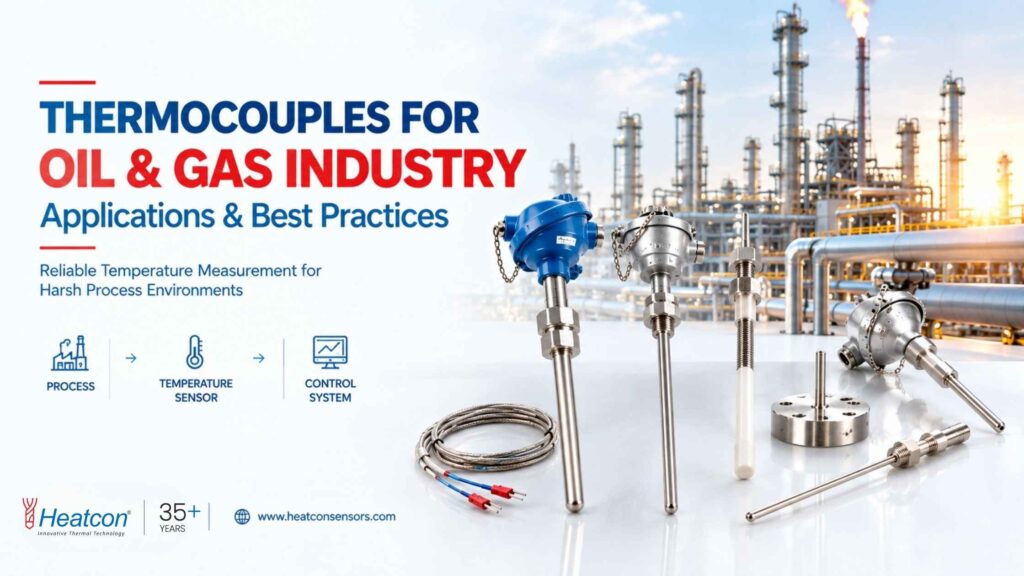
What Are Thermocouples For Oil And Gas Industry?
Thermocouples for oil and gas industry are specialized temperature measurement devices designed to withstand the harsh conditions of exploration, production, refining, and petrochemical processing. According to industry statistics, temperature-related failures are responsible for up to 30% of unscheduled shutdowns in oil and gas operations—leading to losses of millions of dollars annually. Reliable temperature sensing can dramatically reduce these risks, making thermocouples indispensable for the sector.
Thermocouples consist of two dissimilar metals joined at one end, producing a voltage proportional to the temperature difference. Their robustness, broad operating range, and fast response make them ideal for critical and hazardous environments.
Why Are Temperature Sensors Critical In Oil & Gas?
Accurate temperature monitoring is essential in the oil and gas industry for several reasons:
- Safety: Overheating can lead to catastrophic equipment failure or fires.
- Efficiency: Optimized temperature control improves process yields and energy efficiency.
- Compliance: Regulatory bodies mandate temperature monitoring for environmental and safety reasons.
- Asset Protection: Early detection of abnormal temperatures prevents costly downtime and extends equipment life.
In oil and gas temperature sensors, the precision and reliability of thermocouples are unmatched, especially when customized for unique process requirements.
How Are Thermocouples Used In Oil And Gas Operations?
Thermocouple industrial applications in the oil and gas sector cover a wide array of processes, including:
- Extraction: Monitoring temperatures in drilling mud, wellheads, and downhole environments.
- Refining: Managing reactor, furnace, and distillation column temperatures using refinery thermocouples.
- Transport and Storage: Ensuring pipeline and storage tank integrity by monitoring for temperature excursions.
- Petrochemical Processing: Controlling polymerization, cracking, and reforming processes with petrochemical thermocouples.
Industrial process thermocouples are engineered for durability, accuracy, and rapid response, making them vital in these demanding applications.
Types Of Thermocouples Used In Oil & Gas Industry
Selecting the right thermocouple type is crucial. Common types include:
| Type | Temperature Range | Typical Usage | Key Advantages |
|---|---|---|---|
| K Type | -200°C to 1260°C | General process, furnaces, reactors | Wide range, cost-effective, robust |
| N Type | -200°C to 1300°C | Harsh environments, sulfur resistance | Improved stability, oxidation resistance |
| R, S, B Types | 0°C to 1760°C | High temperature furnaces, reformers | High accuracy, long-term stability |
Heatcon Sensors designs and manufactures all these types, customizing sheath materials, tip designs, and mounting options to match specific industrial process thermocouples needs.
What Are The Best Practices For Thermocouple Usage In Oil & Gas?
For optimal performance and reliability, follow these best practices when deploying thermocouples:
- Material Selection: Choose thermocouple alloys and sheath materials compatible with process media (e.g., stainless steel, Inconel, Hastelloy).
- Proper Installation: Ensure firm contact with the process, minimize thermal lag, and prevent vibration or mechanical stress.
- Regular Calibration: Schedule periodic calibration and validation to maintain accuracy.
- Protective Measures: Use thermowells or coatings in corrosive or abrasive environments.
- Documentation: Maintain records of installation, calibration, and replacement for compliance and traceability.
Heatcon Sensors offers expert guidance on application-specific choices and can rapidly supply custom solutions worldwide, including to India, US, UAE, and other oil and gas hubs.
How To Select The Right Thermocouple For Your Facility?
To ensure you obtain the most suitable temperature sensor, consider the following:
- Temperature range requirements
- Environmental conditions (corrosive, explosive, high vibration)
- Required accuracy and response time
- Physical dimensions and mounting constraints
- Regulatory and safety certifications
Heatcon Sensors’ experts can help you specify the right oil and gas temperature sensors tailored to your facility’s needs, from Mumbai to Houston, Abu Dhabi to Jakarta, and beyond.
What Makes Heatcon Sensors The Partner Of Choice For Oil & Gas?
Heatcon Sensors stands out as the preferred supplier for thermocouple industrial applications in the oil and gas sector because:
- Customization: Every sensor is engineered to your process and environmental requirements.
- Global Reach: We ship to any city in India and across the world, ensuring rapid delivery and support.
- Quality Assurance: Each unit undergoes rigorous testing and complies with international standards.
- Comprehensive Solutions: In addition to temperature sensors, we manufacture heat generating equipment such as electric furnaces, ovens, hot air blowers, and high density cartridge heaters.
- Expertise: Decades of experience across upstream, midstream, and downstream applications.
- Responsive Support: Immediate assistance is available via our contact form, WhatsApp, or phone lines.
Not choosing Heatcon Sensors could mean risking unplanned downtime, regulatory penalties, and missed opportunities for operational excellence.
What Are The Key Challenges In Thermocouple Deployment?
Deploying refinery thermocouples and petrochemical thermocouples in complex facilities comes with unique challenges:
- High Temperatures: Processes such as catalytic cracking and reforming reach extreme temperatures.
- Corrosive Environments: Exposure to sulfur, acids, or hydrocarbons can degrade incorrect sensor materials.
- Mechanical Stress: Vibration and flow-induced forces can damage traditional sensors.
- Explosion Risk: Compliance with hazardous area certifications is mandatory.
Heatcon Sensors mitigates these risks through robust design, material selection, and compliance with ATEX, IECEx, and other global standards.
How To Order Custom Thermocouples From Heatcon Sensors?
Ready to enhance your process safety and efficiency? Reach Heatcon Sensors by any of these methods:
- Submit your requirements through our contact form.
- Use the WhatsApp messaging interface on our website for instant chat support.
- Call us at +91 9164833027 or +91 9844233244 for immediate assistance.
Our team will guide you through the specification, quotation, and delivery process—ensuring you receive the right sensor, on time, every time.
About Heatcon Sensors
Heatcon Sensors is an industry-leading manufacturer of customized temperature sensors and heat generating equipment, headquartered in India and serving clients globally. With decades of expertise in manufacturing, innovation, and customer service, Heatcon Sensors is committed to providing the oil and gas sector with world-class thermocouples, RTDs, and heating equipment such as furnaces, ovens, hot air blowers, and high density cartridge heaters.
Our commitment to quality, reliability, and customer satisfaction has made us the trusted partner for oil and gas operations in India, the US, UAE, Indonesia, Germany, South Korea, Saudi Arabia, Russia, Bahrain, Kuwait, and beyond. For more information, visit heatconsensors.com.
Frequently Asked Questions
What are thermocouples and why are they important in the oil and gas industry?
Thermocouples are temperature sensors that generate a voltage based on the temperature difference between two dissimilar metals joined at one end. In the oil and gas industry, thermocouples are essential for monitoring and controlling process temperatures, ensuring safety, improving efficiency, and maintaining product quality in high-temperature environments such as refineries and petrochemical plants.
Which types of thermocouples are most commonly used in refinery applications?
For refinery thermocouples, Types K, J, N, and sometimes R or S are most commonly used due to their wide temperature ranges and stability in harsh process environments. Heatcon Sensors offers a range of refinery thermocouples designed for high reliability and accuracy, even in corrosive and high-vibration refinery settings.
What are the key industrial applications of thermocouples in oil and gas?
Thermocouple industrial applications in oil and gas include furnace monitoring, reactor temperature control, pipeline monitoring, stack temperature measurement, and safety shutdown systems. They are also used in storage tanks, heat exchangers, and flare stacks, where accurate temperature readings are critical for safe and efficient operations.
How do Heatcon Sensors address the challenges faced by thermocouples for oil and gas industry?
Heatcon Sensors provides robust solutions tailored for the demanding conditions of the oil and gas sector. Our thermocouples for oil and gas industry are built with corrosion-resistant materials, high-accuracy elements, and specialized coatings to withstand aggressive chemicals, high pressures, and extreme temperatures. Custom designs and protective sheaths further enhance performance and longevity.
What is the difference between industrial process thermocouples and petrochemical thermocouples?
Industrial process thermocouples refer to general-purpose temperature sensors used in various manufacturing and processing environments, while petrochemical thermocouples are specifically engineered for petrochemical plants where exposure to aggressive chemicals and continuous high temperatures is common. Heatcon Sensors offers both types, with material and design selection optimized for each application.
What best practices should be followed when installing oil and gas temperature sensors?
When installing oil and gas temperature sensors, ensure proper immersion depth, secure mounting to minimize vibration, and use appropriate protective sheaths for corrosive or abrasive conditions. Regular calibration, correct wiring, and following manufacturer guidelines (such as those provided by Heatcon Sensors) will enhance accuracy and sensor life.
Can Heatcon Sensors provide custom thermocouple solutions for unique oil and gas requirements?
Yes, Heatcon Sensors specializes in custom thermocouple solutions. Whether you need non-standard lengths, exotic sheath materials, dual-element designs, or integration with specific process control systems, our engineering team can deliver tailored sensors to meet the precise needs of your oil and gas project.
How do you ensure thermocouple reliability in harsh petrochemical environments?
In petrochemical thermocouples, reliability is achieved through the use of high-grade alloys, protective coatings, and reinforced construction. Heatcon Sensors follows stringent quality control and testing procedures, offering options like mineral-insulated cables, explosion-proof assemblies, and redundant sensor elements to maximize uptime and safety.
What support does Heatcon Sensors offer after installation of temperature sensors?
Heatcon Sensors provides comprehensive technical support, including on-site installation advice, troubleshooting, calibration services, and quick replacement options. Our team ensures your oil and gas temperature sensors operate reliably throughout their service life, minimizing downtime and maximizing process efficiency.