
What Is The Importance Of RTD Tolerance Classes In Critical Environments?
Choosing the right RTD tolerance class can mean the difference between operational success and costly errors in critical environments. According to rtd calibration standards, Class A and Class B RTDs differ in their permissible error margins, directly impacting performance and reliability. In industrial settings, where even a 1°C deviation can lead to significant losses or safety hazards, up to 40% of process disruptions have been attributed to inadequate temperature sensor accuracy.
As industries worldwide—from pharmaceuticals in Germany to petrochemicals in Saudi Arabia—demand tighter temperature control, understanding how to select and apply the correct RTD class is essential. This guide will unravel the differences between Class A RTD sensor and Class B, highlight the role of calibration, and show how Heatcon Sensors can provide unmatched solutions for your most demanding applications, no matter where you are in India or across the globe.
How To Decide Between Class A RTD Sensor And Class B For Your Application?
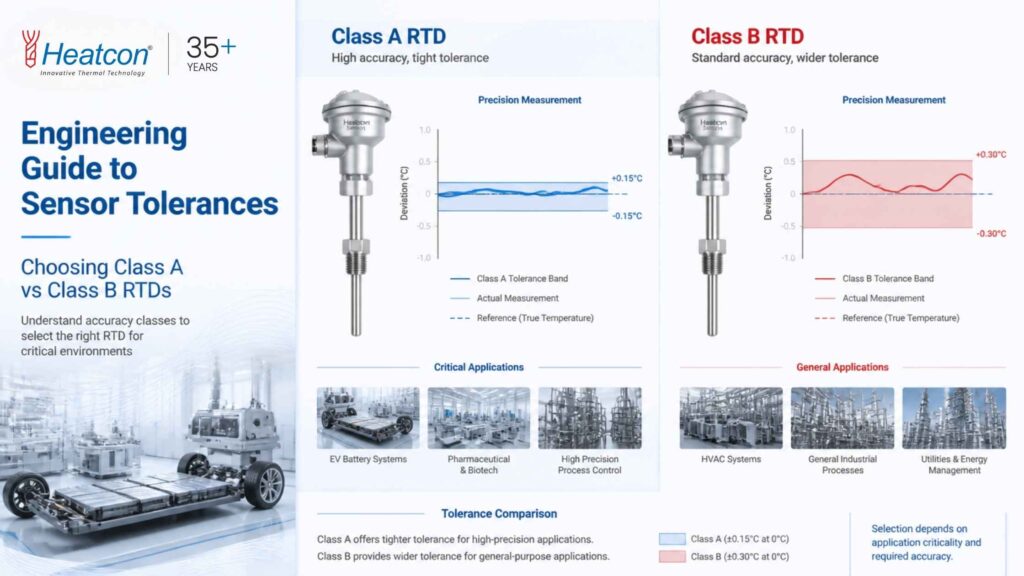
The selection between Class A and Class B RTDs starts with understanding the specific requirements of your application. RTD tolerance classes are set according to international rtd calibration standards, where:
- Class A RTD sensor: Offers higher accuracy and a tighter tolerance band (±0.15°C at 0°C), making it ideal for critical environments such as clean rooms, pharmaceutical production, or aerospace.
- Class B RTD sensor: Permits a wider tolerance (±0.30°C at 0°C), suitable for less critical industrial processes where cost-efficiency is prioritized over ultra-high precision.
For environments where safety, product quality, or regulatory compliance is paramount, opting for a Class A RTD sensor is highly recommended. However, for general process control or where minor variations are acceptable, Class B devices may suffice.
What Are The Key Factors Influencing Temperature Sensor Accuracy?
Temperature sensor accuracy is determined by multiple factors, including the inherent tolerance class, calibration quality, environmental conditions, and installation practices. A crucial aspect is the traceability of calibration to recognized standards—this is where a NABL accredited temperature sensor from Heatcon Sensors provides an edge.
- Element purity and construction: High-purity platinum and robust construction reduce measurement errors and enhance repeatability.
- Industrial RTD calibration: Regular calibration ensures that the device maintains its specified accuracy over time.
- Sensor drift: Prolonged exposure to high temperatures or harsh environments can cause sensor drift, leading to a gradual loss of accuracy.
By choosing Heatcon Sensors, you benefit from rigorous RTD calibration procedures and access to both Class A and Class B sensors tailored to your operational requirements.
Why Is RTD Calibration And Traceability Essential?
RTD calibration is the process of comparing the sensor’s output with a known reference and adjusting it to minimize deviation. The frequency and method of calibration are dictated by rtd calibration standards, which ensure consistency and reliability. For industries operating in strict compliance regimes, such as pharmaceuticals in the US or energy sectors in UAE and South Korea, using a NABL accredited temperature sensor is not just preferred—it’s often mandated.
Heatcon Sensors delivers sensors with full calibration traceability and documentation, supporting industrial RTD calibration programs. This not only assures accuracy but also streamlines audits and regulatory approvals.
How Do RTDs Compare With Thermocouples For Calibration Accuracy?
The debate between RTDs and thermocouples often centers on thermocouple calibration accuracy versus RTD precision. While thermocouples are robust and suitable for extreme temperatures, their calibration accuracy is generally lower than that of RTDs, especially in the critical range of -200°C to 600°C.
- RTDs: Superior linearity and repeatability; ideal for applications where precision and stability are vital.
- Thermocouples: Better suited for high-temperature measurements above 1000°C, though with higher sensor drift and lower repeatability.
When your process demands uncompromising measurement reliability, a properly calibrated RTD from Heatcon Sensors is the smarter choice.
What Are The Advantages Of Choosing Heatcon Sensors For Customized RTDs?
Heatcon Sensors is a pioneering manufacturer of customized RTDs, thermocouples, and other temperature sensors, with a proud legacy of serving industrial requirements across India, the US, UAE, Indonesia, Germany, South Korea, Saudi Arabia, Russia, Bahrain, and Kuwait. Our sensors are engineered to the highest global standards, offering:
- Tailored solutions: Choose from a wide range of RTD tolerance classes and configurations specific to your process.
- Global reach: With the ability to supply to any city in India or worldwide, Heatcon Sensors ensures your operations meet compliance and performance goals wherever you are.
- Accredited excellence: Our NABL accredited temperature sensor portfolio assures unmatched quality and traceability.
- Comprehensive support: From design to delivery and ongoing industrial RTD calibration services.
- Calibration and documentation: Full adherence to rtd calibration standards and industry best practices.
What Other Heat Generating Equipment Does Heatcon Sensors Manufacture?
Beyond temperature sensors, Heatcon Sensors is a leader in the manufacturing of heat generating equipment, including:
- Electric furnaces
- Industrial ovens
- Hot air blowers
- High density cartridge heaters
- Custom-designed heating elements for specialized industrial applications
- Laboratory and process heating systems
Each product is designed with a focus on efficiency, safety, and long-term reliability, supporting industries like automotive, pharmaceuticals, chemicals, and more, both in India and internationally.
How To Reduce Sensor Drift And Maintain Long-Term Accuracy?
Sensor drift can erode the accuracy of any temperature measurement system over time, especially in harsh industrial environments. To combat this, Heatcon Sensors recommends:
- Regular RTD calibration following accredited procedures.
- Using Class A RTD sensor in environments where precision is non-negotiable.
- Implementing robust installation and maintenance procedures.
- Choosing sensors with a proven track record for low drift and high stability.
Our technical team offers guidance on best practices and can custom-engineer solutions to minimize drift, ensuring that your critical processes remain under precise control.
What Is The Heatcon Sensors Difference?
Heatcon Sensors is not just a manufacturer—it is a trusted engineering partner for organizations where temperature control is mission-critical. With a customer-first approach, we offer:
- Expertise in RTD calibration standards and global compliance requirements.
- Rapid turnaround and worldwide logistics support, including to Germany, Saudi Arabia, Russia, the US, Bahrain, Kuwait, and every major city in India.
- Customized documentation and certificates for smooth regulatory audits.
Don’t let subpar sensors or inaccurate measurements compromise your operations. Choosing Heatcon Sensors means you’re investing in reliability, compliance, and peace of mind.
Ready to optimize your temperature measurement systems? Submit your information on the form at our Contact Us page, leave a message on WhatsApp via our website, or call +91 9164833027 or +91 9844233244 for immediate assistance. Ensure your critical environments are protected with the most accurate and reliable RTDs in the industry.
About Heatcon Sensors
Heatcon Sensors is a globally recognized manufacturer based in India, specializing in customized RTDs, thermocouples, and advanced temperature measurement solutions. With NABL accreditation and a reputation for excellence, Heatcon delivers precision, reliability, and compliance to industries worldwide. Our legacy of innovation and customer-centric service ensures your temperature monitoring challenges are met with world-class expertise.
Connect with us today to experience the Heatcon difference for yourself—delivering accuracy, compliance, and confidence wherever your operations take you.
Frequently Asked Questions
What are RTD tolerance classes and how do they affect sensor selection?
RTD tolerance classes, commonly Class A and Class B, define the permitted deviation from the true resistance value at specific temperatures. Class A RTD sensors have tighter tolerances and therefore provide higher temperature sensor accuracy, making them ideal for critical environments where precision is paramount. Class B RTDs allow for a slightly broader deviation, suitable for less demanding applications. The choice between them depends on your required accuracy and the criticality of your process.
When should I choose a Class A RTD sensor over a Class B RTD?
A Class A RTD sensor is recommended for critical process environments where even minor temperature deviations can impact quality or safety, such as in pharmaceuticals, food processing, or scientific research. Class A sensors meet stricter rtd calibration standards, ensuring lower uncertainty. Class B RTDs are suitable for general industrial applications where ultra-high accuracy is not essential.
How does RTD calibration impact long-term performance and reliability?
RTD calibration ensures that the sensor readings are accurate and traceable to recognized standards. Over time, sensor drift can cause readings to deviate from actual temperatures. Regular industrial RTD calibration, ideally performed by a NABL accredited temperature sensor laboratory like Heatcon Sensors, helps maintain accuracy, detect drift, and extend sensor life, ensuring reliable data for your processes.
Why is NABL accreditation important for temperature sensor calibration?
NABL accreditation signifies that a laboratory meets stringent international standards for calibration and testing. Choosing a NABL accredited temperature sensor calibration partner like Heatcon Sensors ensures that your RTDs are calibrated with traceability, precision, and reliability, which is especially critical for regulated industries and quality audits.
How does sensor drift affect temperature measurements over time?
Sensor drift is the gradual deviation of a sensor’s output from the true value, usually caused by aging, harsh environments, or repeated thermal cycling. It leads to reduced temperature sensor accuracy and can impact process control if not addressed. Routine RTD calibration and maintenance, such as services offered by Heatcon Sensors, minimize drift effects and help detect when a sensor needs replacement or recalibration.
Can Heatcon Sensors provide calibration for both RTDs and thermocouples?
Yes, Heatcon Sensors is equipped to handle both RTD calibration and thermocouple calibration accuracy requirements. Their NABL accredited laboratory ensures that both sensor types are calibrated to international standards, supporting optimal performance across a range of industrial applications.
What are the internationally recognized rtd calibration standards?
RTD calibration is typically performed in accordance with standards such as IEC 60751 and ASTM E2877, which define resistance-temperature characteristics and testing procedures. Heatcon Sensors adheres to these rtd calibration standards, ensuring all sensors deliver reliable and repeatable results in critical environments.
How often should industrial RTD calibration be performed?
The frequency of industrial RTD calibration depends on the application, operating environment, and quality requirements. For critical processes, annual calibration is recommended, while less demanding applications may allow for a longer interval. Heatcon Sensors offers customized calibration schedules and reminders to help maintain compliance and sensor performance.
How does Heatcon Sensors ensure high temperature sensor accuracy for demanding environments?
Heatcon Sensors delivers high temperature sensor accuracy by manufacturing RTDs to strict RTD tolerance classes, using premium materials, and offering comprehensive calibration services in their NABL accredited temperature sensor laboratory. From Class A RTD sensor selection to post-installation RTD calibration, Heatcon helps customers achieve reliable, traceable measurements in the most demanding industrial settings.