
What Is PID Tuning In Industrial Temperature Control?
PID tuning temperature control loop refers to the process of adjusting the proportional (P), integral (I), and derivative (D) settings of a PID temperature controller to achieve accurate, stable, and responsive process temperature control. Proper tuning ensures minimal controller overshoot, fast settling time, and steady industrial oven thermal equilibrium. In industries ranging from food processing to advanced manufacturing, the quality of PID tuning can make the difference between consistent product quality and costly rework.
Why Is Ziegler-Nichols Method Temperature Tuning Preferred?
The Ziegler-Nichols method temperature tuning is one of the most respected and widely adopted techniques for setting PID parameters. Developed in the 1940s, it provides a systematic, data-driven approach to process loop controller adjustment. By finding the ultimate gain and oscillation period in a controlled environment, the Ziegler-Nichols method delivers a reliable starting point for PID settings that can be fine-tuned to perfection.
- Proven: Used globally in industries that demand precision.
- Simple to Apply: Requires minimal prior knowledge of system dynamics.
- Effective for a Wide Range of Processes: Ideal for both slow and fast thermal systems.
How Does PID Tuning Temperature Control Loop Work In Practice?
In a typical process temperature control scenario, the goal is to maintain a specific setpoint despite disturbances. The PID temperature controller continuously adjusts the control output based on the deviation from the setpoint, integrating feedback from sensors such as RTDs and thermocouples. If the PID parameters are poorly tuned, the system may oscillate, overshoot, or respond sluggishly, leading to instability and inefficiency.
Key steps for effective PID tuning:
- Set the controller to manual mode and stabilize the process at the desired setpoint.
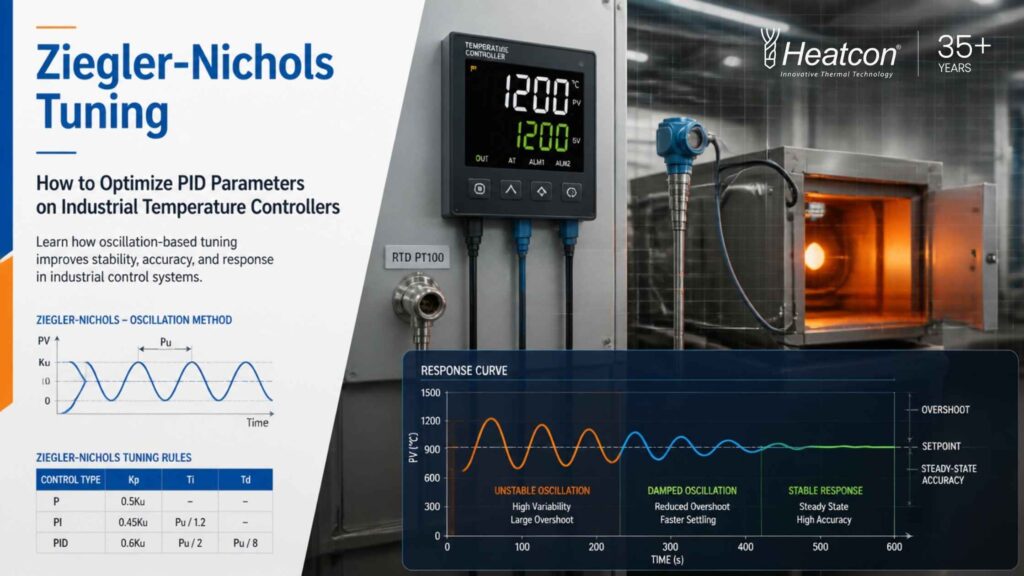
- Increase the proportional gain until sustained oscillations are observed—this is the ultimate gain.
- Note the oscillation period (ultimate period).
- Apply the Ziegler-Nichols formulas to calculate the initial PID settings.
- Switch to automatic mode, observe performance, and fine-tune as needed for thermal process optimization.
What Are The Benefits Of Proper Temperature Loop Tuning?
Accurate temperature loop tuning delivers immediate and long-term benefits to industrial operations:
- Faster response times: Reach setpoint quickly after process disturbances.
- Reduced controller overshoot: Prevents overheating and product defects.
- Stable industrial oven thermal equilibrium: Maintains uniformity in batch and continuous processes.
- Energy efficiency: Minimizes wasted energy in furnaces, ovens, and heating systems.
- Consistent product quality: Ensures repeatability in sensitive applications like pharmaceuticals, food, and electronics.
Which Industries Rely On PID Temperature Controllers?
PID temperature controller technology is at the heart of countless industrial and laboratory processes, especially where thermal stability is mission-critical. Some key applications include:
- Furnaces and electric furnaces (metallurgy, ceramics, glass manufacturing)
- Ovens and industrial baking (food and beverage, specialty materials)
- Hot air blowers and HVAC systems (building management, clean rooms)
- High density cartridge heaters (plastic molding, die casting, packaging equipment)
- Process reactors and chemical plants (petrochemicals, pharmaceuticals)
Any process that depends on precise and repeatable heating can benefit from expertly tuned PID loops—and custom-engineered sensors to match.
How Does Process Loop Controller Adjustment Impact Efficiency?
Timely process loop controller adjustment is essential for accommodating changes in raw materials, environmental conditions, and equipment aging. Even the best-designed temperature control systems can drift over time. Routine PID review, recalibration, and sensor health checks help ensure that your process temperature control remains robust, maximizing productivity and minimizing downtime.
Heatcon Sensors specializes in supporting process engineers with calibration-grade RTDs, thermocouples, and control solutions tailored to your unique requirements—no matter where your facility is located.
How To Use Ziegler-Nichols Method Temperature For Rapid PID Setup
The Ziegler-Nichols method temperature procedure is a time-tested way to establish initial PID settings with minimal guesswork. Here is a snippet-friendly step-by-step guide:
- Set integral and derivative actions to zero on your PID controller.
- Gradually increase the proportional gain until the output oscillates at a constant amplitude.
- Record the ultimate gain (Ku) and ultimate period (Pu).
- Apply these values to the Ziegler-Nichols formula for your desired control type (P, PI, or PID):
| Control Type | P | PI | PID |
|---|---|---|---|
| Proportional Gain (Kp) | 0.5 Ku | 0.45 Ku | 0.6 Ku |
| Integral Time (Ti) | – | Pu/1.2 | Pu/2 |
| Derivative Time (Td) | – | – | Pu/8 |
After this initial setup, observe the system response and adjust parameters for optimal performance, focusing on minimizing overshoot and achieving fast, stable equilibrium.
Why Partner With Heatcon Sensors For Industrial Temperature Control?
Heatcon Sensors is a leading manufacturer of customized RTDs, thermocouples, and temperature sensors tailored for industrial requirements. With decades of expertise, Heatcon Sensors serves clients across India, the US, UAE, Indonesia, Germany, South Korea, Saudi Arabia, Russia, Bahrain, Kuwait, and globally. Our commitment to quality and innovation ensures seamless integration with your PID temperature controller, supporting advanced thermal process optimization in the most demanding environments.
- Custom engineering: Sensors designed for unique process challenges and harsh environments
- Global logistics: Rapid, reliable delivery to any region or industrial city
- Full thermal solutions: From sensors to heat generating equipment—furnaces, ovens, hot air blowers, electric furnaces, and high density cartridge heaters
- Expert support: Guidance in sensor selection, installation, and PID parameter tuning
How Can I Get Expert Assistance For PID Tuning And Sensor Selection?
Don’t let poor tuning or unreliable sensors limit your productivity or product quality. Heatcon Sensors offers end-to-end support for PID tuning temperature control loop, sensor customization, and process loop controller adjustment.
You can easily reach out to our technical team for personalized guidance:
- Submit your information on our online form
- Leave a message on WhatsApp via the interface on our website
- Call us directly for immediate assistance: +91 9164833027 or +91 9844233244
Experience the difference that world-class sensor technology and expert process control support can make for your operations—no matter where you are in the world.
About Heatcon Sensors
Heatcon Sensors is a globally recognized manufacturer and supplier of customized temperature sensors and heat generating equipment. Headquartered in India, we serve industrial clients in the US, Europe, Middle East, and Asia, delivering precision-engineered RTDs, thermocouples, furnaces, ovens, hot air blowers, electric furnaces, and high density cartridge heaters. Our deep expertise and commitment to quality make us your trusted partner for all thermal process optimization needs.
Frequently Asked Questions
What is the Ziegler-Nichols method for temperature control, and how does it assist in PID tuning?
The Ziegler-Nichols method temperature tuning approach is a widely adopted technique for setting PID controller parameters. By systematically increasing the proportional gain on a process loop controller adjustment until sustained oscillations are observed, you can determine the ultimate gain and period. These values are then used to calculate optimal PID settings. This method speeds up the temperature loop tuning process and provides a good starting point for achieving stable process temperature control in industrial environments.
How does Heatcon Sensors support thermal process optimization in industrial ovens?
Heatcon Sensors offers advanced temperature measurement solutions and expertise in PID temperature controller integration for industrial ovens. Our sensors provide precise data, critical for achieving industrial oven thermal equilibrium and consistent product quality. Combined with our guidance on PID loop tuning and controller setup, we help clients achieve reliable thermal process optimization and energy efficiency.
Why is achieving thermal equilibrium important in process loop controller adjustment?
Achieving thermal equilibrium ensures the temperature is stable and uniform throughout the industrial oven or process environment. This stability is essential for accurate PID tuning temperature control loop settings, as it minimizes temperature gradients and the risk of controller overshoot. Heatcon Sensors’ products help maintain this equilibrium by providing fast, accurate sensor feedback for real-time process adjustments.
What are the common challenges when using PID temperature controllers in industrial applications?
Common challenges include improper temperature loop tuning, excessive controller overshoot, slow response to setpoint changes, and external disturbances affecting the process. Heatcon Sensors addresses these with accurate sensors and expert advice on PID tuning, ensuring robust process temperature control and minimizing production losses.
How does Heatcon Sensors help with process temperature control optimization?
Heatcon Sensors provides a combination of high-precision temperature sensors and expert technical support for setting up and optimizing PID temperature controller parameters. Our team helps clients use methods like Ziegler-Nichols to fine-tune their process loop controller adjustment, resulting in stable, responsive, and efficient temperature control systems.
What is controller overshoot and how can it be minimized during PID tuning?
Controller overshoot occurs when the process temperature exceeds the target setpoint before settling, often due to aggressive tuning or insufficient damping. It can be minimized by careful adjustment of PID parameters—especially the proportional and derivative terms—during temperature loop tuning. Heatcon Sensors provides accurate sensor data that allows for precise PID adjustments, reducing overshoot and improving product consistency.
Can Heatcon Sensors’ products be integrated with advanced PID temperature controllers?
Yes, Heatcon Sensors’ offerings are fully compatible with modern PID temperature controller models used in industrial settings. Our sensors are designed for seamless integration, ensuring accurate feedback for automated process temperature control and supporting advanced functions such as remote monitoring and adaptive control.
What steps should be followed for effective temperature loop tuning in a new thermal process?
Effective temperature loop tuning involves selecting the right sensor placement, using reliable sensors like those from Heatcon Sensors, and applying a systematic tuning procedure such as the Ziegler-Nichols method temperature. After initial setup, observe the process response, adjust PID parameters to achieve minimal overshoot and steady-state error, and validate performance under typical operating conditions. Continuous monitoring ensures long-term process stability.
How do Heatcon Sensors contribute to long-term reliability in thermal process optimization?
Heatcon Sensors manufactures robust, accurate temperature sensors that withstand harsh industrial environments. Their reliability ensures consistent temperature readings, which are critical for ongoing PID tuning temperature control loop adjustments and thermal process optimization. This leads to improved process efficiency, reduced downtime, and consistent product quality.