When it comes to the reliability of temperature measurement and control in extreme environments, the durability of insulation in mineral insulated cables is paramount. Did you know that over 80% of process industries rely on mineral insulated thermocouples for operations where temperatures soar above 1000°C? This statistic demonstrates the critical importance of insulation choice in ensuring both safety and performance. In this comprehensive guide, we dive deep into the world of magnesium oxide insulation cables and alumina-insulated alternatives, comparing their high-temperature durability, performance, and suitability for heavy-duty applications. Discover how Heatcon Sensors, a leading mineral insulated cable manufacturer, can be your trusted partner for customized, world-class solutions delivered anywhere in India or globally.
The Importance of Insulation in Heavy-Duty MI Cables
Insulation within mineral insulated cables serves two essential functions: it electrically isolates the conductor wires and provides crucial protection from thermal, mechanical, and chemical stresses. In heavy-duty industrial settings, the choice between magnesium oxide and alumina as insulation material can determine the lifespan and reliability of measurement and heating systems.
- Prevents electrical shorting and leakage
- Maintains signal integrity at extreme temperatures
- Protects sensors and heaters from corrosive and high-pressure environments
Magnesium Oxide as a Standard for High Temperature Cabling
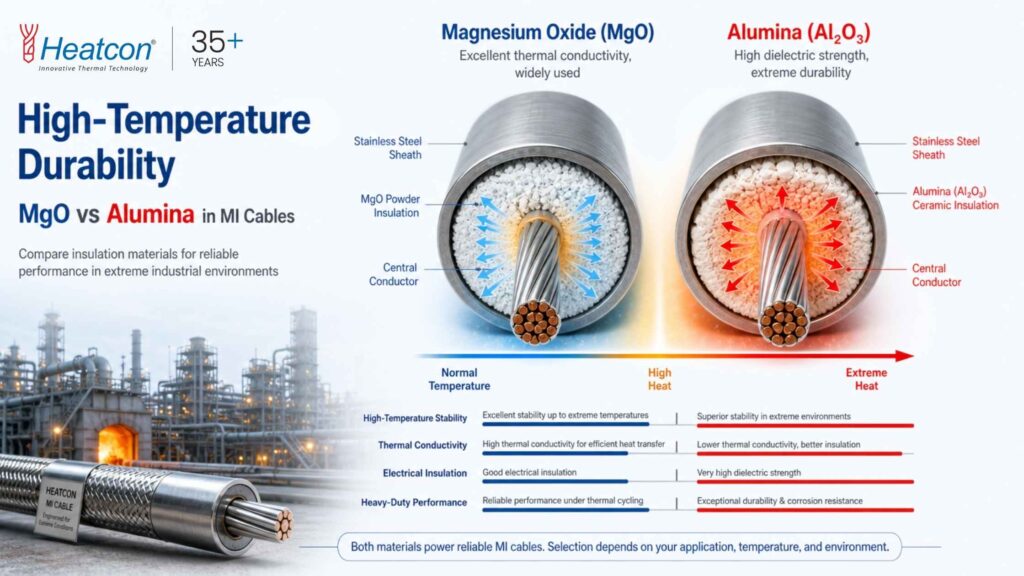
Magnesium oxide insulation cables have become the gold standard for high-temperature applications due to their unique balance of thermal conductivity, electrical insulation, and cost-effectiveness. Magnesium oxide, derived from calcined magnesite, is highly stable even at temperatures up to 1200°C, making it ideal for most heavy-duty MI cable construction scenarios.
Key Benefits of Magnesium Oxide Insulation Cables:
- Exceptional electrical insulation up to 1000°C and beyond
- High thermal conductivity to minimize response time for temperature sensors
- Low moisture absorption, ensuring long-term reliability
- Cost-effective for wide-scale industrial MI cables manufacturing
Heatcon Sensors leverages decades of expertise to custom-build magnesium oxide insulation cables that meet the stringent MI thermocouple cable specification requirements of diverse industries—from steel and glass manufacturing to oil refineries and energy plants.
Alumina Insulation for Extreme Temperatures
While magnesium oxide excels in most scenarios, alumina insulation is preferred for ultra-high temperature cabling needs, particularly where temperatures regularly exceed 1200°C. Alumina (Al2O3), with its melting point above 2000°C, offers superior resistance to chemical attack and thermal shock.
Advantages of Alumina Over Magnesium Oxide:
- Higher maximum operating temperature (up to 1800°C)
- Greater resistance to aggressive chemical and reducing atmospheres
- Longer lifespan in continuous high-heat environments
However, alumina insulation is more expensive and less thermally conductive than magnesium oxide, which may impact the sensitivity and cost of high temperature sensor cable solutions. Heatcon Sensors provides comprehensive engineering guidance to help clients balance these trade-offs for their specific applications.
Typical MI Cable Construction for Heavy-Duty Use
The core of reliable mineral insulated thermocouples and RTDs lies in their robust MI cable construction. Regardless of the insulation material, the basic structure remains:
- Inner conductors (thermocouple alloys, platinum, nickel, etc.)
- Compacted mineral insulation (magnesium oxide or alumina)
- Protective metal sheath (stainless steel, Inconel, Hastelloy, etc.)
This combination delivers unmatched mechanical strength, flexibility, and thermal cable insulation performance. Heatcon Sensors, as a mineral insulated cable manufacturer, offers bespoke MI cable construction tailored to your site’s temperature, pressure, and chemical exposure requirements.
Comparing Magnesium Oxide and Alumina Insulation for Industrial MI Cables
Selecting the right insulation depends on application specifics. Here’s a quick comparison to guide your decision:
| Property | Magnesium Oxide | Alumina |
|---|---|---|
| Max Operating Temp | ~1200°C | ~1800°C |
| Thermal Conductivity | High | Moderate |
| Chemical Resistance | Good (except in reducing atmospheres) | Excellent |
| Cost | Lower | Higher |
| Common Applications | General industrial MI cables, furnace probes, RTDs | Glass, ceramics, metallurgy, high-end process sensors |
For most industrial MI cables, magnesium oxide insulation provides the best balance of performance and value. However, for extreme environments, alumina may be the only reliable option.
Applications of High Temperature Sensor Cable
High temperature sensor cable is integral to critical process control across industries:
- Furnace and oven temperature monitoring
- Petrochemical process control
- Power generation and turbine temperature measurement
- Steel, glass, and ceramics manufacturing
- Pharmaceutical sterilization and food processing
Heatcon Sensors supplies customized MI thermocouple cable specification designs for these and many other sectors globally.
Heatcon Sensors’ Approach to Industrial Needs
Heatcon Sensors is not just a mineral insulated cable manufacturer. We are a solutions partner, delivering end-to-end thermal cable insulation and measurement systems. Our expertise includes:
- Custom RTDs and thermocouples with magnesium oxide or alumina insulation
- Industrial MI cables for high temperature cabling and process automation
- Heat generating equipment, such as furnaces, ovens, hot air blowers, electric furnaces, high density cartridge heaters, immersion heaters, tubular heaters, and more
- Rapid prototyping and mass production for clients in India, US, UAE, Indonesia, Germany, South Korea, Saudi Arabia, Russia, Bahrain, Kuwait, and worldwide
Every solution is engineered for reliability, accuracy, and compliance with global standards. Our reach and logistics allow us to deliver anywhere—whether you’re located in a major city or a remote industrial hub.
Key Advantages of Working with Heatcon Sensors
Heatcon Sensors stands out through a commitment to quality, customization, and service. Here’s what you gain by partnering with us:
- In-depth application engineering support from concept to commissioning
- Bespoke sensor and cable configurations to match your exact MI cable construction requirements
- Worldwide supply chain and rapid turnaround time
- Extensive portfolio including all types of thermal cable insulation, high temperature sensor cable, and heat generating equipment
- Strict adherence to international MI thermocouple cable specification guidelines
Our team’s expertise ensures that you never have to compromise on performance or safety—no matter how demanding your process environment.
Ordering Custom MI Cables and Heaters
Getting started with Heatcon Sensors is easy. Choose from any of the following options:
- Submit your requirements via our secure web form at https://heatconsensors.com/contact-us/
- Leave a message on WhatsApp through the interface available on our website
- Call our experts directly at +91 9164833027 or +91 9844233244 for immediate assistance
Don’t let subpar insulation or generic solutions jeopardize your production efficiency or safety. Secure the best-in-class mineral insulated thermocouple and custom high temperature cabling today.
About Heatcon Sensors
Heatcon Sensors is a renowned mineral insulated cable manufacturer based in India, specializing in custom-designed temperature sensors, RTDs, thermocouples, and industrial heating equipment. With a global client base, Heatcon Sensors delivers precision-engineered solutions that power some of the most demanding industrial processes worldwide. Our commitment to innovation, quality, and customer satisfaction makes us the preferred partner for organizations seeking reliability and performance in thermal measurement and heat generation.
Frequently Asked Questions
What is the difference between magnesium oxide and alumina insulation in MI cables?
Magnesium oxide insulation cables and alumina-insulated cables both use mineral insulation, but magnesium oxide (MgO) is the standard choice due to its excellent electrical insulation, thermal conductivity, and cost-effectiveness. Alumina (Al 2 O 3 ) insulation offers superior mechanical strength and even higher temperature tolerance, but at a higher cost and with reduced flexibility. Heatcon Sensors, as a leading mineral insulated cable manufacturer, offers both types for applications requiring high temperature cabling and robust performance.
How do magnesium oxide insulation cables perform at elevated temperatures?
Magnesium oxide insulation cables are renowned for their high temperature durability, typically performing reliably up to 1000°C, depending on MI cable construction and sheath material. This makes them ideal for high temperature sensor cable applications in power plants, furnaces, and other industrial MI cables deployments. Heatcon Sensors’ magnesium oxide insulated solutions ensure stable insulation resistance and minimal signal drift even under harsh thermal cycling.
When is alumina insulation recommended over magnesium oxide in MI cables?
Alumina insulation is preferred in extreme environments where temperatures exceed the limits of magnesium oxide or where chemical stability and mechanical strength are critical. Alumina can withstand temperatures up to 1800°C, making it suitable for specialized high temperature cabling and mineral insulated thermocouple assemblies used in aerospace, metallurgy, and glass manufacturing. Heatcon Sensors provides tailored MI thermocouple cable specification with alumina insulation for such demanding needs.
What are the key factors in selecting the right MI thermocouple cable specification?
The right MI thermocouple cable specification depends on temperature range, environment, mechanical stress, and sensor response requirements. Critical factors include core material, insulation type (magnesium oxide or alumina), sheath alloy, diameter, and thermal cable insulation properties. Heatcon Sensors offers expert guidance to match the MI cable construction to your process and safety requirements, ensuring accurate and reliable temperature measurement.
How does Heatcon Sensors ensure the high-temperature durability of their MI cables?
Heatcon Sensors employs rigorous quality control, advanced manufacturing processes, and careful selection of raw materials for mineral insulated thermocouple and high temperature sensor cable assemblies. Each cable undergoes testing for insulation resistance, mechanical integrity, and conformance to international standards, ensuring long-term performance even in the harshest industrial MI cables environments.
What applications benefit most from magnesium oxide insulation cables?
Magnesium oxide insulation cables are extensively used in power generation, petrochemicals, steel plants, and industrial furnaces, where high temperature cabling reliability is paramount. Their excellent thermal cable insulation and electrical properties make them suitable for process control, safety monitoring, and critical temperature sensing tasks. Heatcon Sensors provides a wide range of configurations for these demanding applications.
Are there any limitations to using magnesium oxide in MI cable construction?
While magnesium oxide provides excellent performance for most industrial MI cables, it can become hygroscopic if exposed to moisture, potentially impacting insulation resistance over time. Proper sealing and installation are critical. For environments with severe thermal cycling or aggressive chemicals, alumina insulation or special protective sheaths from Heatcon Sensors may be recommended to maintain cable integrity.
How does Heatcon Sensors support custom requirements for high temperature cabling?
As a trusted mineral insulated cable manufacturer, Heatcon Sensors specializes in designing and producing custom MI cable construction, including unique sheath alloys, insulation materials, and conductor types to suit client-specific high temperature sensor cable requirements. Whether you need special thermal cable insulation or a unique MI thermocouple cable specification, our engineers are ready to deliver optimal solutions.