
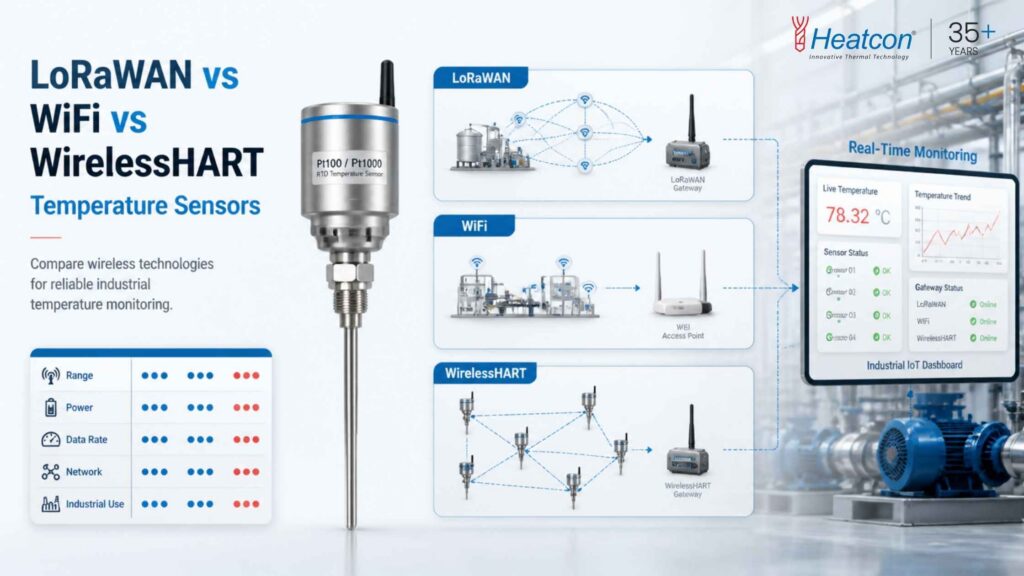
What Is The Difference Between LoRaWAN, WiFi, And WirelessHART Temperature Sensors?
The difference between LoRaWAN Temperature Sensor, WiFi temperature sensor, and WirelessHART sensors lies in their communication protocols, range, power efficiency, and suitability for industrial environments. LoRaWAN excels in long-range, low-power applications. WiFi sensors are ideal for high-data environments but are limited by range and power consumption. WirelessHART is purpose-built for secure, robust industrial communication with self-healing mesh networking.
Did you know that the global industrial wireless sensor network market is projected to reach $8.67 billion by 2026? This explosive growth is driven by the adoption of smart sensors and IIoT connectivity, with industries recognizing the importance of reliable temperature monitoring for safety, efficiency, and compliance. In this guide, we unravel the intricate differences between LoRaWAN Temperature Sensor, WiFi temperature sensor, and WirelessHART sensors, helping you make an informed decision for your industrial needs.
Why Accurate Temperature Sensing Matters in Industry
Accurate temperature sensing is the backbone of operational safety and process efficiency in industries such as pharmaceuticals, oil & gas, food processing, energy, and manufacturing. With the risks of overheating, thermal runaway, and product spoilage, selecting the right sensor and communication protocol is paramount. Heatcon Sensors, a trusted leader in customized RTDs and temperature sensors, enables you to tailor your temperature monitoring solutions, ensuring precision and reliability.
How Does a LoRaWAN Temperature Sensor Work?
A LoRaWAN Temperature Sensor utilizes the LoRaWAN protocol, which stands for “Long Range Wide Area Network.” LoRaWAN enables sensors to transmit data over distances of up to 15 kilometers in rural environments, making it ideal for remote sensing in dispersed industrial settings. The sensor records temperature data and sends it via a low-power radio signal to a gateway, which then relays the data to a central cloud or local server for monitoring and analysis.
- Ultra-low power consumption: Batteries can last several years.
- Excellent for wireless monitoring over large campuses or outdoor installations.
- Supports integration with IIoT connectivity platforms for real-time analytics.
- Best suited for applications where cabling is impractical or costly.
Heatcon Sensors manufactures and customizes LoRaWAN RTD assemblies, ensuring compatibility with the most demanding industrial environments. This allows seamless deployment in cities and countries worldwide, including India, US, UAE, Indonesia, Germany, South Korea, Saudi Arabia, Russia, Bahrain, and Kuwait.
What Is A WiFi Temperature Sensor And When Should You Use It?
A WiFi temperature sensor connects directly to a local WiFi network, transmitting temperature data in real-time to cloud dashboards or control systems. These sensors are popular in environments where WiFi infrastructure is already established, such as modern factories, warehouses, and smart buildings.
- High data throughput: Suitable for frequent, real-time updates.
- Easy integration with existing IT networks and cloud services.
- Limited by WiFi signal range (typically up to 100 meters indoors).
- Higher power consumption compared to LoRaWAN and WirelessHART.
Heatcon Sensors can engineer WiFi temperature sensor solutions that integrate seamlessly with your existing network, providing rapid deployment and enhanced visibility across your operations. Whether you are in bustling industrial hubs of India or global markets, Heatcon’s technology ensures you are always connected to the pulse of your plant.
How Do WirelessHART Sensors Enhance Industrial Communication?
WirelessHART sensors utilize the WirelessHART protocol, a secure, self-organizing, and self-healing mesh network standard designed specifically for process automation. Each sensor communicates with its neighbors, ensuring multiple pathways for data to travel back to the gateway, thus offering unparalleled reliability and resilience.
- Mesh networking reduces the risk of communication failure.
- Industry-standard security and interoperability.
- Optimized for harsh industrial environments with high EMI/RFI.
- Supports a wide range of industrial communication protocols.
Heatcon Sensors’ expertise in WirelessHART sensors ensures that your temperature monitoring system is both robust and scalable, easily adapting to evolving process requirements across the globe.
Which Industrial Communication Protocol Is Best For Your Application?
Selecting the ideal industrial communication protocol depends on several factors: site layout, data update frequency, power constraints, and required security levels. Here’s a quick comparison to guide your decision:
| Feature | LoRaWAN Temperature Sensor | WiFi Temperature Sensor | WirelessHART Sensors |
|---|---|---|---|
| Range | Up to 15 km (rural) | Up to 100 m (indoors) | Mesh network; extends with more nodes |
| Power Consumption | Very low | Moderate to high | Low |
| Data Rate | Low | High | Medium |
| Security | Good (AES encryption) | Depends on network | High (industry standard) |
| Environment | Outdoor, remote, dispersed | Indoor, smart buildings | Process plants, refineries |
Can You Achieve Remote Sensing With All Three Technologies?
Yes, remote sensing is achievable with LoRaWAN Temperature Sensor, WiFi temperature sensor, and WirelessHART sensors. However, LoRaWAN provides the greatest flexibility for remote, hard-to-reach locations due to its extended range and low power requirements. WirelessHART excels in complex industrial environments, while WiFi is best for accessible sites with robust network infrastructure.
Heatcon Sensors empowers industries with tailored remote sensing solutions, ensuring you never lose sight of critical temperature data, regardless of where your assets are located.
Why Are Smart Sensors And IIoT Connectivity Essential For Modern Industry?
Smart sensors and IIoT connectivity are revolutionizing industrial operations by enabling predictive maintenance, automating data collection, and supporting real-time analytics. These technologies reduce downtime, optimize process control, and enhance decision-making for plant managers worldwide.
Heatcon Sensors integrates smart sensors into every solution, making sure your facility benefits from the latest advancements in IIoT connectivity—whether you’re upgrading a legacy system or building a new smart factory from scratch.
Why Choose Heatcon Sensors For Your Temperature Sensing Needs?
With decades of expertise, Heatcon Sensors stands at the forefront of customized temperature sensor manufacturing. From LoRaWAN RTD and RTDs to thermocouples, and from small-batch customizations to high-volume production, Heatcon Sensors delivers quality, precision, and reliability.
- Custom manufacturing for every industrial requirement.
- Ability to supply to any part of India or the world, including US, UAE, Indonesia, Germany, South Korea, Saudi Arabia, Russia, Bahrain, and Kuwait.
- Engineered to meet the highest standards of durability and accuracy.
In addition to temperature sensors, Heatcon Sensors manufactures a comprehensive range of heat generating equipment, including:
- Electric furnaces
- Industrial ovens
- Hot air blowers
- High density cartridge heaters
- Immersion heaters, tubular heaters, band heaters, and more
These products are designed to work seamlessly with advanced temperature monitoring systems, ensuring complete process control from heat generation to precise measurement.
How To Order Customized Temperature Sensors From Heatcon Sensors?
Don’t let outdated or generic sensors compromise your plant’s safety or efficiency. Unlock the full potential of modern temperature sensing with Heatcon Sensors. Choose from three easy ways to get started:
- Submit your requirements through the online form at https://heatconsensors.com/contact-us/
- Leave a message on WhatsApp using the interface available on the Heatcon Sensor’s website
- Call for immediate assistance at +91 9164833027 or +91 9844233244
Join leading industries across India, US, UAE, Indonesia, Germany, South Korea, Saudi Arabia, Russia, Bahrain, and Kuwait who trust Heatcon Sensors for their critical temperature monitoring needs.
About Heatcon Sensors
Heatcon Sensors is a premier manufacturer and supplier of customized temperature sensors, RTDs, thermocouples, and heat generating equipment. Headquartered in India and serving clients worldwide, Heatcon Sensors combines engineering excellence with customer-centric solutions to address the most demanding industrial applications.
For innovative, reliable, and tailored temperature sensing solutions—choose Heatcon Sensors.
Frequently Asked Questions
What are the main differences between LoRaWAN, WiFi, and WirelessHART temperature sensors?
The primary differences lie in their industrial communication protocols and network topologies. A LoRaWAN Temperature Sensor is ideal for long-range, low-power, remote sensing applications, especially in large industrial sites. A WiFi temperature sensor offers higher bandwidth and is suited for environments with existing WiFi infrastructure but has shorter range and higher power consumption. WirelessHART sensors are based on a robust, self-healing mesh network, specifically designed for industrial automation, offering secure and reliable data transmission even in harsh conditions. Heatcon Sensors offers solutions in all these protocols, ensuring versatility for your industrial needs.
Which wireless temperature sensor network is best for large-scale industrial environments?
For extensive industrial sites, LoRaWAN Temperature Sensor and WirelessHART sensors are both excellent choices. LoRaWAN supports long-distance communication and remote sensing with minimal infrastructure, while WirelessHART’s mesh network ensures high reliability and redundancy. Heatcon Sensors can help you select the best option depending on your process requirements, site layout, and existing IIoT connectivity infrastructure.
How does Heatcon Sensors ensure secure and reliable wireless monitoring in industrial settings?
Heatcon Sensors integrates advanced encryption and authentication methods into all wireless products, including LoRaWAN RTD , WiFi temperature sensor , and WirelessHART sensors . Our solutions employ industry-proven industrial communication protocols to safeguard data integrity and reliability, even in electromagnetically noisy or hazardous environments.
What is a LoRaWAN RTD and how does it benefit process industries?
A LoRaWAN RTD combines the accuracy of a Resistance Temperature Detector (RTD) with LoRaWAN wireless technology. This offers robust, battery-powered, low-maintenance wireless monitoring and remote sensing of process temperatures across wide industrial facilities. Heatcon Sensors supplies LoRaWAN RTDs tailored for continuous process monitoring and integration with modern IIoT connectivity platforms.
Can Heatcon Sensors provide smart sensors compatible with IIoT connectivity?
Yes, Heatcon Sensors offers a range of smart sensors supporting IIoT connectivity , including LoRaWAN, WiFi, and WirelessHART based temperature sensors. These smart devices enable seamless data integration with cloud platforms, SCADA, and other industrial control systems, paving the way for digital transformation and predictive maintenance.
How do LoRaWAN Temperature Sensors reduce maintenance costs?
LoRaWAN Temperature Sensor solutions are engineered for low power consumption, often running on batteries for years without replacement. This minimizes maintenance visits and costs, especially in remote or hazardous areas. Heatcon Sensors’ LoRaWAN devices are designed for easy installation and reliable long-term operation in industrial environments.
What are the advantages of using WiFi temperature sensors in industrial plants?
A WiFi temperature sensor is ideal for sites with robust WiFi coverage, offering fast data transmission and integration with existing IT systems. Heatcon Sensors provides WiFi temperature sensors that support real-time temperature monitoring, easy configuration, and compatibility with various industrial and commercial platforms, enabling flexible wireless monitoring .
How do WirelessHART sensors enhance reliability in process automation?
WirelessHART sensors form a self-healing mesh network, automatically rerouting data if a connection fails. This ensures high data reliability and uptime. Heatcon Sensors’ WirelessHART temperature sensors are built for seamless integration into existing WirelessHART networks, making them ideal for process automation and critical temperature measurements.
Does Heatcon Sensors offer support and customization for wireless temperature sensing solutions?
Absolutely. Heatcon Sensors specializes in custom-engineered LoRaWAN Temperature Sensor solutions, WirelessHART sensors , and WiFi temperature sensor systems to match unique industrial needs. Our experts assist with network design, device selection, installation, and ongoing support to maximize the benefits of wireless monitoring and remote sensing for your operations.