
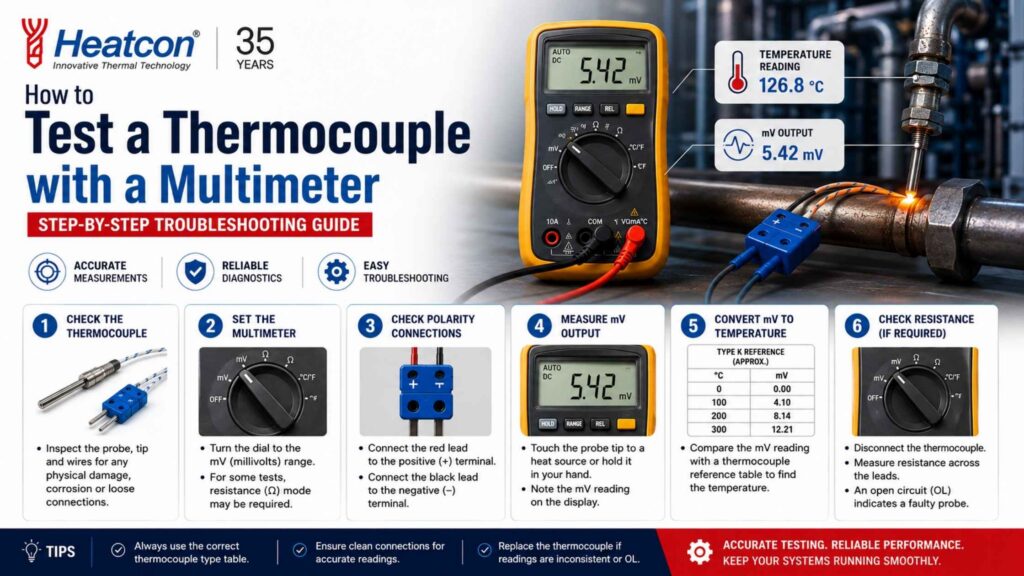
This step-by-step troubleshooting guide will arm you with everything you need to know about thermocouple testing. You’ll learn not just the core testing procedures, but also advanced tips, common pitfalls, and why Heatcon Sensors—India’s most trusted manufacturer of custom RTDs, thermocouples, and heat generating equipment—should be your first choice for temperature control solutions globally. Read on to ensure your plant, bakery, or laboratory never falls victim to unexpected temperature sensor failures again.
What Is a Thermocouple and Why Is Testing Important?
A thermocouple is a simple yet powerful temperature sensor made by joining two dissimilar metals that generate a small voltage proportional to the temperature difference across the junctions. Because thermocouples are rugged, fast-responding, and usable in a wide range of industrial applications, their reliability is critical. However, exposure to high temperatures, corrosive environments, or mechanical stress can cause them to fail or drift, making regular thermocouple troubleshooting essential.
Regular testing prevents unexpected breakdowns in critical heat generating equipment—like industrial furnaces, ovens, hot air blowers, and advanced electric furnaces—by detecting faults early. Heatcon Sensors, headquartered in India and serving clients in the US, UAE, Germany, Indonesia, South Korea, Russia, Bahrain, and Kuwait, are experts at custom-manufacturing and supplying robust, accurate temperature sensors for every industrial need.
How to Test a Thermocouple With a Multimeter: Step-by-Step
The fastest way to determine the health of your thermocouple is to test thermocouple with multimeter. Here’s how you can do it:
- Disconnect the Thermocouple: Always isolate the thermocouple from the circuit or device to prevent inaccurate readings or electrical hazards.
- Set the Multimeter: Adjust the multimeter to measure millivolts (mV), as this is the typical voltage range generated by thermocouples.
- Connect the Probes: Attach the multimeter’s probes to the thermocouple wires—usually red (+) and white (−) for standard types.
- Apply Heat: Gently heat the thermocouple’s sensing tip using a lighter or another heat source. Watch the multimeter for a change in voltage.
- Observe the Reading: A healthy thermocouple will display an increasing voltage in millivolts as the temperature rises. Compare the readings to standard thermocouple tables based on type (K, J, T, etc.).
These straightforward steps can be applied to any installation—from a bakery oven in Mumbai to a laboratory in Frankfurt. If the voltage remains flat, erratic, or far from expected values, you may be facing a faulty thermocouple testing scenario.
What Is Thermocouple Millivolt Testing?
Thermocouple millivolt testing is the process of measuring the minute voltage produced by a thermocouple when exposed to heat. Typically, this voltage is in the range of 1–50 mV, depending on the temperature and thermocouple type. The procedure is essential for diagnosing sensor integrity and performance.
- Millivolt readings that deviate significantly from reference tables indicate potential issues such as corrosion, open circuits, or incorrect installation.
- Consistent millivolt output across several tests and temperatures suggests the thermocouple is healthy.
For industries relying on precise thermal control—such as pharmaceuticals in South Korea, petrochemicals in the UAE, or ceramics in Indonesia—accurate millivolt testing is a non-negotiable maintenance routine. Heatcon Sensors supplies high-precision test equipment, guidance, and custom thermocouple solutions to ensure your millivolt readings are always on target.
What Are the Signs of a Faulty Thermocouple?
Spotting a failing sensor before it causes downtime is vital. Here’s what to look for during faulty thermocouple testing:
- Zero or negative millivolt output, even when heated
- Fluctuating or unstable voltage readings
- Physical damage, such as cracks or corrosion at the junction
- Inconsistent or inaccurate temperature reporting compared to known standards
If you notice any of these symptoms, immediate replacement or recalibration is crucial. Heatcon Sensors provides not only rapid diagnostics but also custom replacement sensors manufactured and shipped to any part of India or the world—backed by decades of experience in industrial temperature management.
How to Troubleshoot a Thermocouple Step-by-Step
Thermocouple troubleshooting is a structured process that minimizes downtime and ensures accurate temperature control. Here’s a proven approach:
- Visual Inspection: Check for physical damage, discoloration, or corrosion around the probe and connection points.
- Continuity Test: Use your multimeter in resistance mode (ohms) to check for open circuits. An infinite reading signals a break in the sensor wire.
- Millivolt Check: Perform the thermocouple millivolt testing as described above.
- Compare Readings: Contrast your results with known standards or another working thermocouple.
- Replace or Repair: If faults are detected, consult Heatcon Sensors for rapid replacement or expert repair services.
Heatcon Sensors also offers advanced diagnostic services and technical support to help clients in Germany, Russia, Kuwait, and across the globe optimize their processes and prevent failures.
Why Choose Heatcon Sensors for Your Thermocouple and Heating Needs?
Heatcon Sensors is India’s leading manufacturer and exporter of customized RTDs, thermocouples, and temperature sensors for industrial applications. Our expertise goes beyond standard solutions—we engineer bespoke sensors tailored to your equipment, process, and regulatory requirements, serving every corner of India and the world, including the United States, UAE, Saudi Arabia, Bahrain, Indonesia, South Korea, Germany, and Russia.
- Complete portfolio: From standard thermocouples to high-density cartridge heaters, industrial ovens, hot air blowers, and electric furnaces.
- Global reach: Fast shipping and dedicated support for clients in all major industrial hubs worldwide.
- Cutting-edge technology: Advanced testing and calibration for uncompromised precision and reliability.
- Unmatched customization: Any sensor, any specification, any destination—delivered with Heatcon’s proven quality.
Don’t risk unexpected production losses or compliance issues due to faulty sensors. Choose Heatcon Sensors—the partner trusted by industry leaders from Mumbai to Moscow.
How to Contact Heatcon Sensors for Customized Solutions
Ready to enhance your temperature sensing and heating systems? Reach out to Heatcon Sensors today using any of these convenient options:
- Submit your information on the contact form.
- Leave a message via Whatsapp through the interface on Heatcon Sensor’s website.
- Call directly for immediate assistance: +91 9164833027 or +91 9844233244.
Our technical experts are always ready to guide you with the perfect solution for your industrial needs, no matter where you are in India or the world.
About Heatcon Sensors
Heatcon Sensors is a renowned manufacturer based in India, specializing in customized temperature sensors, thermocouples, RTDs, and a wide range of heat generating equipment including industrial ovens, electric furnaces, and high-density cartridge heaters. With a strong legacy of quality, innovation, and customer satisfaction, Heatcon Sensors serves industries in India, the US, UAE, Indonesia, Germany, South Korea, Saudi Arabia, Russia, Bahrain, Kuwait, and beyond.
For the most reliable, accurate, and custom-engineered solutions in temperature measurement and industrial heating, trust only Heatcon Sensors.
Frequently Asked Questions
What is the correct way to test a thermocouple with a multimeter?
To test a thermocouple with multimeter, first disconnect the thermocouple from the system. Set the multimeter to measure millivolts (mV). Connect the multimeter probes to the thermocouple wires. Heat the sensing tip using a lighter or other heat source and observe the voltage reading. A functioning thermocouple should produce a small, but steady increase in millivolts. If there’s no or erratic reading, the thermocouple may be faulty and should be replaced. For more guidance, Heatcon Sensors offers detailed troubleshooting guides and support.
How does thermocouple millivolt testing help identify faults?
Thermocouple millivolt testing is a key process in determining if your sensor is working correctly. By measuring the voltage output generated when the thermocouple is heated, you can compare the results to manufacturer specifications. If the voltage is significantly lower than expected, or absent, it indicates wiring issues, sensor damage, or connection problems. Heatcon Sensors provides support and calibration services to ensure precise millivolt readings and optimal sensor performance.
What are the most common signs that indicate thermocouple troubleshooting is needed?
Frequent temperature fluctuations, inconsistent equipment operation, or no response from your temperature controller often mean thermocouple troubleshooting is necessary. Physical damage to the thermocouple, corrosion, or loose connections are also warning signs. Using a multimeter can help pinpoint the issue quickly. Heatcon Sensors recommends routine maintenance and offers replacement thermocouples for all industrial needs.
Which steps should I follow for faulty thermocouple testing?
For faulty thermocouple testing, start by visually inspecting for obvious damage. Next, disconnect the thermocouple and measure resistance with your multimeter; infinite resistance suggests a break. Follow up with millivolt testing while applying heat to the tip. If the voltage output is absent or inconsistent, the thermocouple is likely faulty. Heatcon Sensors can assist in diagnosing and supplying high-quality replacements.
What multimeter settings should I use when testing a thermocouple?
Set your multimeter to the millivolt (mV) DC range when performing thermocouple millivolt testing. For continuity checks or open circuit detection, use the resistance (Ohms) setting. Always ensure probes are clean and connections are secure for accurate readings. If you are unsure, Heatcon Sensors’ technical team can guide you on correct multimeter usage for your specific thermocouple type.
Are there safety precautions to take when testing thermocouples with a multimeter?
Yes, always disconnect power to the equipment before testing. Avoid touching the heated tip directly and use insulated tools. Ensure the area is dry and free from flammable materials. If you’re unsure about the procedure, consult a qualified technician or reach out to Heatcon Sensors for professional assistance.
How can Heatcon Sensors help if my thermocouple fails during testing?
Heatcon Sensors offers expert support in both thermocouple troubleshooting and replacement. If your thermocouple is found faulty during testing, we provide a wide range of compatible sensors, customization options, and technical advice to get your system running efficiently again. Our customer service ensures you receive the right product and installation guidance.
Can Heatcon Sensors provide guidance for different thermocouple types during testing?
Absolutely. Heatcon Sensors specializes in a variety of thermocouple types (J, K, T, E, etc.), and can walk you through the appropriate test thermocouple with multimeter procedures for each type. Our team can help interpret readings and ensure your testing aligns with industry standards for accuracy and safety.
How often should I conduct thermocouple testing and maintenance?
Regular thermocouple testing is recommended as part of preventive maintenance, especially in critical industrial processes. Frequency depends on usage conditions, but quarterly or bi-annual checks are common. Heatcon Sensors can help set up a maintenance schedule and provide replacement or calibration services as needed.